

What happened to Homestar Runner?
 By Obscure Internet

 11 min read
Homestar Runner never shut down: it slowed down. The weekly Flash cartoons stopped in 2009, when their makers, the brothers Mike and Matt Chapman, had young families and needed proper jobs, and since 2014 the site has posted new cartoons a few times a year, with the old ones still playing through a Flash emulator after Flash itself died at the end of 2020.
So the site you remember is still there, at the same address, made by the same two people. It just doesn’t update every Monday any more.

What is Homestar Runner?
Homestar Runner is a cartoon series that lives on its own website, homestarrunner.com. It’s set in a place called Free Country, USA, and its star is Homestar, a cheerful, armless, slightly dim athlete in a propeller cap. In the words of a 2003 student newspaper profile, he’s “an athletic but sweet simpleton who is usually too nice for his own good”.
From the museum

Around him is a small cast of what the brothers call “dumb animal characters”: his friend Pom Pom, his girlfriend Marzipan, the gym teacher Coach Z, the shopkeeper Bubs, and the three Strong brothers. Strong Bad wears a Mexican wrestling mask and boxing gloves and is mean to everybody. Strong Mad shouts. Strong Sad is quietly miserable. And The Cheat is a small yellow creature who squeaks and helps Strong Bad with his schemes.
It was made in Flash, it was free, and for a few years in the early 2000s it was the cartoon everybody at school or at work had seen. In 2003 the site was getting as many as 250,000 visitors a day, and Wired put its Monday audience at almost 300,000.
For the sites that collected everybody else’s Flash cartoons, see Badger Badger Badger and the Flash cartoon sites.
Who made Homestar Runner?
Homestar Runner was made by Mike and Matt Chapman, two brothers from Atlanta who call themselves the Brothers Chaps. They wrote, drew, animated and voiced nearly all of it between them, and their friend Melissa Palmer was the voice of Marzipan.
The characters themselves were first drawn by Mike and their friend Craig Zobel, now a filmmaker. The name came from a friend mangling a terrible local Atlanta grocery advert that featured one of the Braves: in his version, the player became a “homestar runner”. The brothers thought it was hilarious, and the phrase stuck.
The Chapmans were the youngest of five, and they’ve said their humour came from taking “some terrible Atlanta commercial” and repeating part of it “5,000 times to make a joke”. Anyone who’s watched more than three Homestar cartoons will recognise the method.
When did Homestar Runner start?
It started as a book in 1996. During the Atlanta Olympics that summer, Mike and Craig got bored, went to a bookshop, looked at the children’s books and decided to make a terrible one of their own. In about two hours they came up with Homestar, Pom Pom, Strong Bad, The Cheat and Strong Mad, all at once. The book was called The Homestar Runner Enters the Strongest Man in the World Contest.
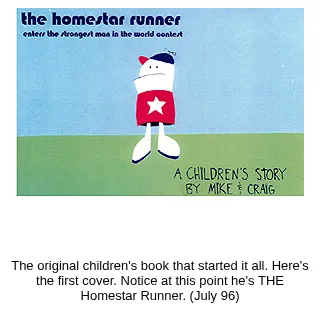
They only printed five or ten copies, for friends. But their dad, without telling them, sent it to about 80 publishers. “I remember being pissed at him when I found out,” Mike said later. A couple of rejection letters came back, and that was that for a few years.
Then Mike, who’d been studying photography, got interested in the web, picked up some Flash tutorial books and dropped out of graduate school. He and Matt needed something to practise on, so they dug out the old characters. homestarrunner.com went live in January 2000.
What were Strong Bad Emails?
Strong Bad Emails were short cartoons in which Strong Bad sat at his computer (for many of the best-remembered years, an ancient one called the Compy 386) and answered an email from a real fan. He usually sang a little song while it booted up, then made fun of the sender’s name, spelling and grammar before going off on some wild tangent.
They started in 2001, and they quickly took over the site. “In 2001, when we started Strong Bad e-mail, he’d already become everybody’s favorite character,” Mike told Wired. The brothers had planned a show about the nice hero. The audience wanted the rude one.
The emails came out every Monday. The brothers spent their Sundays sorting through tens of thousands of fan emails, then writing, recording and animating through the night, sometimes until 8am. Matt was still working at EarthLink, and he’s thanked the company since for letting him come in at 11am instead of 9am.
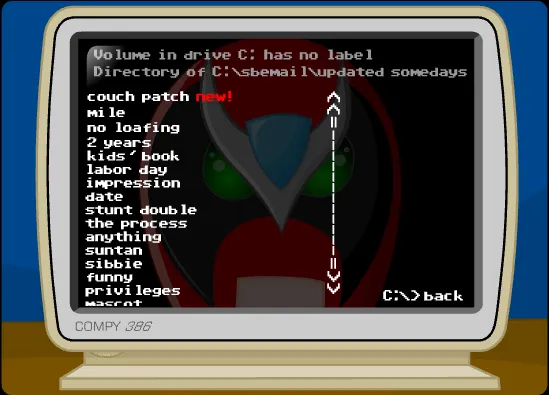
Plenty of the internet’s longest-running jokes started in these emails. In email 53, “comic”, in 2002, Strong Bad debuted Teen Girl Squad, his very own comic about teenage girls. In email 58, “dragon”, in 2003, a fan asked him to draw a dragon, and he drew Trogdor the Burninator: an S-shaped dragon with one muscly arm, burninating the countryside to a ridiculous heavy metal song. Trogdor got his own T-shirts and, later, a place in Guitar Hero II.
The 100th email arrived in 2004. The 200th, “email thunder”, went up in 2008.
How did Homestar Runner make money?
It sold T-shirts and other merchandise, and that was it. There were never any adverts.
The first shirt went on sale in 2001, and to buy it you had to post a cheque to the brothers’ parents’ house. Their dad did the accounts. By September 2002, Matt told a student newspaper, the shirts and other merchandise made enough for the brothers to live on, and in 2003 their financially careful dad told Matt to quit his job and do Homestar full time.

They were firm about the ads. People told them that two banner ads running for two months would pay for the site for a year, Matt said in 2003, but “that’s just not worth it. Ads are the worst thing on the Internet.” Their dad once suggested a button at the end of each cartoon saying “Buy a shirt with Strong Bad on it!”, and they told him that was “so lame”. They even made toys of Cheat Commandos, their spoof of G.I. Joe, and then refused to advertise them in the cartoon.
Matt has called 2002 to 2005 the years they “got to go the most nuts creatively”: CDs, DVDs, puppets, live action, games and toys. His favourite day was in February 2004, when a demo arrived from John Linnell of They Might Be Giants, who’d recorded a song for a Strong Bad Email, and on the same day a working Tom Servo puppet turned up from Jim Mallon of Mystery Science Theater 3000. There were Homestar jokes in the finales of Buffy the Vampire Slayer and Angel, and a photo of Joss Whedon in a Strong Bad shirt.
What happened to Homestar Runner?
Life happened. By 2010 both brothers were married with children, and the shirts weren’t going to pay for two families forever. “We always knew our business model was temporary,” Mike said in 2017. They went on hiatus after Matt’s second daughter was born and went to work in children’s television, on shows including Yo Gabba Gabba! and Gravity Falls.
They were also tired. They’d made a cartoon a week for close to ten years, and Mike remembered the Sunday all-nighter as “this cloud looming over me”. The last regular Strong Bad Email, number 205, went up in 2009.
What they didn’t do was say anything. “After a certain point it almost became weird to say something about the break,” Mike said. Matt admitted they’d “probably bummed people out”, but felt it would have pulled back the curtain too far to announce that they’d gone to write a Yo Gabba Gabba! Christmas special. So for years, homestarrunner.com just sat there, with the odd cartoon now and then and no explanation.
How did Homestar Runner come back?
On 1 April 2014, after about four years of near silence, a new cartoon appeared. It was an April Fools’ joke about Homestar finally updating his dusty, neglected website. The brothers chose April Fools’ Day on purpose, Matt said, so that if nobody cared, they could claim it was all part of the joke and disappear for another ten years.
People cared. Matt, who’d spent three years in Los Angeles working on Gravity Falls, was moving back to Atlanta, and Homestar made sense again. In October 2014 they put up a new cartoon, a hip-hop song about fisheye lenses, and told Rolling Stone it wouldn’t be their full-time job this time: “We’re not going to stay awake all night just to finish a Strong Bad email.”
On 1 April 2015, the 206th Strong Bad Email went up, the first since 2009. Since then the emails have come slowly: 207 in 2017, 208 in 2018, 209 in 2022 and 210, “robots”, in 2025. The holiday cartoons kept coming in between.
How did Homestar Runner survive the end of Flash?
The whole site was built in Flash, and Adobe stopped supporting Flash Player at the end of 2020, so this was a real problem.
The brothers’ first move was a joke. In December 2020 they finally finished level 10 of Stinkoman 20X6, a Mega Man spoof whose first nine levels came out in 2005. Matt explained that the 15-year delay wasn’t because they’d been adding “all this awesome stuff”. They “literally didn’t work on it for 15 years”. The trailer called it “Prolly not worth the wait.”
As 2020 turned into 2021, visitors found a roadworks sign instead of the site.
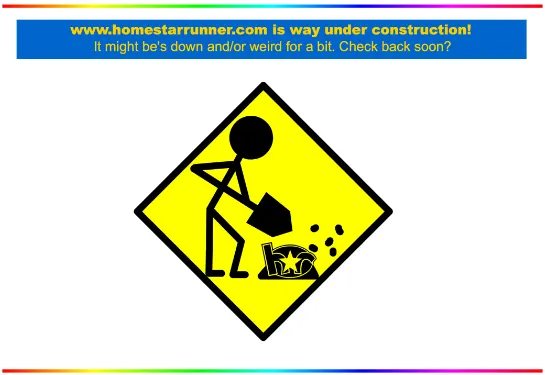
What came back was a new front page with a post called “Post-Flash Update!”. Once you clicked “come on in”, it said, you’d find yourself “in familiar territory thanks to the Ruffle Project”, an emulator that “emulates Flash in such a way that all browsers and devices can finally play our cartoons and even some games”. The cartoon and email menus now worked like normal web pages, the hidden Easter eggs were still there, and you could pick a YouTube version of a cartoon where there was one. The brothers were upfront about the gaps: games made after about 2007 would “probably be pretty janky”, and cartoons with video in them would show an empty box.
If you lost a lot of your favourite Flash things when it died, you’re in good company. Flash games went the same way, and Newgrounds, the other great home of Flash cartoons, used the same emulator to keep its archive alive. Even the grey Adobe Flash Player is blocked box has its own card in the museum.
Can you still watch Homestar Runner?
Yes. The official home is still the brothers’ own site, homestarrunner.com (here it is in October 2026). It has every Strong Bad Email in one list (as of September 2026), numbered up to 210, from “some kinda robot” in 2001 to “robots” in 2025, and the old cartoons and games play in the browser through Ruffle. Expect the later games to be a bit wobbly. The brothers also post cartoons to their official YouTube channel.
The brothers are still making things. Trogdor became a real board game in 2018: the Kickstarter, made with the game designer James Ernest, launched on 17 July, beat its $75,000 goal in under three hours and closed on 15 August with more than $1.42 million from more than 23,000 backers. In September 2026 came another, Crime Scene Tamperer, a $19.95 party game made with Greater Than Games and starring Strong Bad’s alter ego, the crooked detective Dangeresque. The site’s front page also offers a Homestar add-on for the VR game Walkabout Mini Golf and merchandise celebrating 25 years of the site.
It’s not every Monday any more, and it won’t be again. But Homestar Runner is one of the very few early web cartoons still being made by the people who made it, at the address it started at, without a single advert.
Homestar Runner: a timeline
- July 1996: Mike Chapman and Craig Zobel make the picture book The Homestar Runner Enters the Strongest Man in the World Contest.
- January 2000: homestarrunner.com goes live with Flash cartoons by Mike and Matt Chapman.
- 2001: The first T-shirt goes on sale, by cheque only, and Strong Bad answers his first email.
- 2002: Strong Bad Email 53 introduces Teen Girl Squad. By September the brothers can live off the merchandise.
- 2003: Strong Bad Email 58 introduces Trogdor the Burninator. Their dad tells Matt to quit his day job.
- 2004: The 100th Strong Bad Email.
- 2008: The 200th Strong Bad Email, “email thunder”.
- 2009: The last regular Strong Bad Email, number 205. The site goes quiet.
- 1 April 2014: An April Fools’ cartoon ends nearly four years of silence.
- 1 April 2015: Strong Bad Email 206, the first since 2009.
- July to August 2018: Trogdor!! The Board Game raises more than $1.42 million on Kickstarter.
- December 2020: Stinkoman 20X6 level 10 arrives, 15 years late, weeks before Flash support ends.
- January 2021: The site relaunches with its cartoons running in the Ruffle emulator.
- 2025: Strong Bad Email 210, “robots”.
- September 2026: Crime Scene Tamperer, a Dangeresque party game, goes on sale.
More from the same years waits in The Messenger Years, and the games of the era are in the best old Flash games.
Opens in a new tab
Sources
Each link opens a saved copy in the Internet Archive’s Wayback Machine, in a new tab, as the page was when we read it.
- An Oral History of Homestar Runner, the Internet's Favorite Cartoon, by Luke Winkie (Gizmodo, 24 January 2017)
- The Homestar Runner Enters the Strongest Man in the World Contest (homestarrunner.com, June 2001)
- Homestar site hands out advice and brings laughs, by Tim Agne (The State Press, 27 August 2003)
- Homestar Runner interview, by Kari Lynn Dean (Wired News, 23 June 2003)
- Homestar Runner Returns: Inside a Cult Classic's Comeback, by James Montgomery (Rolling Stone, 3 October 2014)
- Watch The First Strong Bad Email From Homestar Runner Since 2009 (BGR, 1 April 2015)
- Internet Nostalgia Just Powered This 'Homestar Runner' Board Game (Fatherly, 18 July 2018)
- Trogdor!! The Board Game (Kicktraq)
- 'Homestar Runner' creators revive 15-year-old game right before Flash dies, by Nathan Ingraham (Engadget, 21 December 2020)
- Post-Flash Update! (homestarrunner.com, 2021)
- Sbemails, the full list (homestarrunner.com, September 2026)
- homestarrunner.com home page (October 2026)
- Homestar Runner Debuts Crime Scene Tamperer Board Game, by Michael Walsh (Nerdist, 11 September 2026)
From the museum
