

What happened to Friends Reunited?
 By Obscure Internet

 10 min read
Friends Reunited closed on 26 February 2016, after nearly 16 years. Its founders, who’d taken it back two years earlier, switched the servers off because it no longer covered its costs, and members’ profiles went with it, apart from a one-off chance to download their photos.
If you were in Britain in 2001, you probably remember the moment it arrived. Suddenly everyone in the office was looking up the people they’d sat next to in double maths, and finding out who’d gone bald, who’d gone to Australia and who’d married the head girl. It was Britain’s first big social network, years before most of us had heard of Facebook.
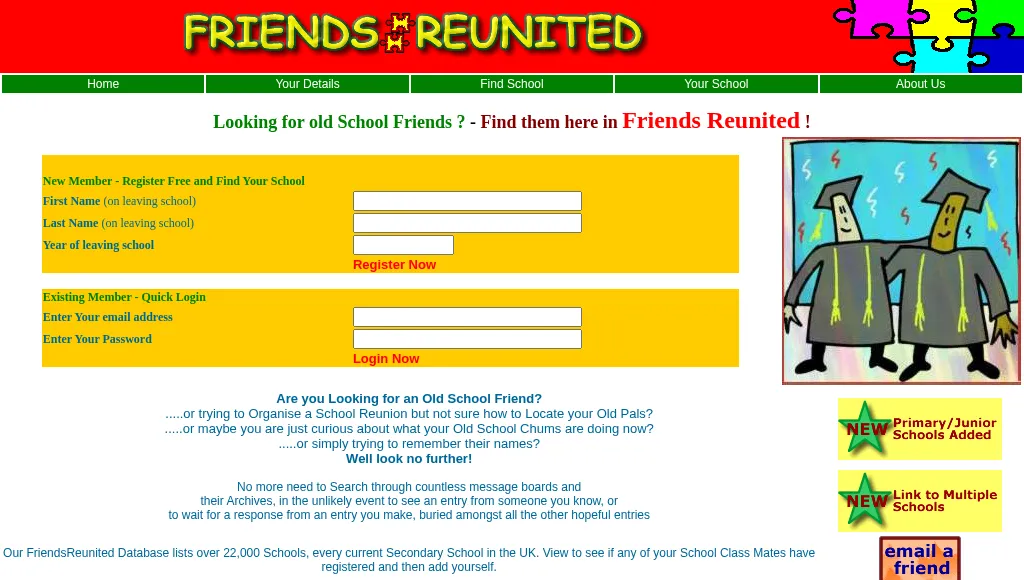
When did Friends Reunited start, and who founded it?
Friends Reunited went live in July 2000, from the spare bedroom of a semi-detached house in Barnet, on the northern edge of London. It was built by Steve and Julie Pankhurst and their friend and business partner Jason Porter.
From the museum

The idea was Julie’s. In July 1999, pregnant with their first child, she started wondering what had happened to her old school friends. Were they married? Did they have children? Did they still live round the corner? She worked out that all you’d need was a list of every school, a way to put your name against the one you went to, and a page showing who else had done the same. She planned to learn to build it on maternity leave, which, as Steve later wrote on the site, was before either of them knew quite what a newborn baby would demand.
So Steve wrote it in his spare time, while working full-time as a consultant, after what he cheerfully called “months of Julie nagging me”. In February 2000 he and Jason had set up a little company, HappyGroup, to try out internet ideas without borrowing any money, and this was one of them.
The first version, in the picture above, is as simple as it looks. You typed in your name as it was when you left school, and the year you left, and found your school among more than 22,000 in the database. Within a few weeks, one of the handful of early members emailed to say he’d met up with a school friend for the first time in more than 30 years.
How did Friends Reunited get so big?
Slowly, then all at once. By the end of 2000 it had about 3,000 members, and the Pankhursts were spending every spare hour answering emails and adding schools that had closed. In December they gave it a new look, with a logo made from photos of Steve’s mum and dad and two friends.
Then, in January 2001, Steve Wright made it Website of the Day on his Radio 2 show. Tens of thousands of listeners tried to log on at once, and the site’s “poor little single server”, as Steve put it, fell over again and again. He and Jason worked through the night to keep bringing it back. That week, 3,000 people signed up.
From there it snowballed. The site’s own history counts 19,000 members in February 2001, 96,000 by May, and more than a million by August, when nearly 15 servers were handling up to 5 million hits a day. The Pankhursts’ kitchen filled with takeaway boxes. GMTV took over their house one morning for a live broadcast. By October 2001 there were 2 million members, and Friends Reunited had become what Steve called “a genuine talking point in offices, pubs and dinner parties”.
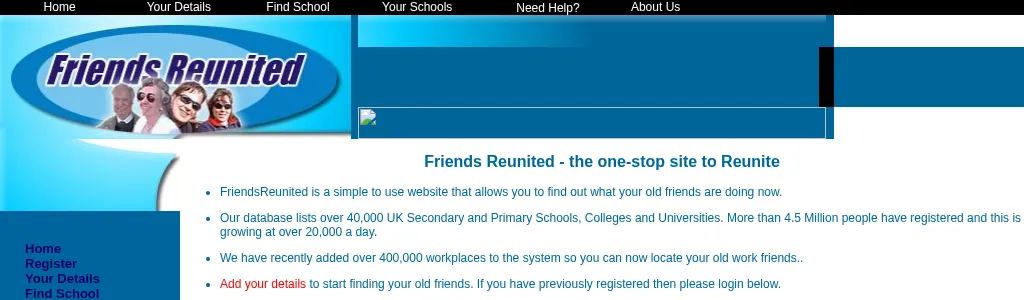
It kept adding things. Workplaces came in February 2002, so you could look up old colleagues too. Sites for Australia, New Zealand and South Africa followed that June, then Spain, Italy and the Netherlands. In November 2002 came GenesConnected, a family-tree site that grew into the business’s quiet success. There was even an April Fool in 2002 called PawsReunited, and a lot of people tried to register their pets. By October 2003 the home page claimed more than 8 million members, with 15,000 more joining every day.
The reunions, and the headlines
The point of it all was the reunion, and for the Pankhursts that sometimes meant one in front of a camera crew. Steve’s own primary school reunion was filmed for Channel 4 and shown in September 2001, at the same time as England’s 5-1 win over Germany, so hardly anyone saw it.
The papers loved the love stories. Childhood sweethearts found each other again and got married, and in August 2002 the site celebrated the first Friends Reunited baby. Inevitably, there were also stories of marriages ending after someone looked up an old flame. Steve’s view, years later, was fair enough: “You can’t blame the technology.”
The memory boards could be less sweet. Members swapped stories about their old teachers, and in November 2001 those boards were taken down for a while after teaching unions complained about what was being posted. In 2002 a retired teacher won £1,250 in libel damages from a former pupil over comments posted about him on the site.
Why did you have to pay to use Friends Reunited?
Because nobody else would. By late 2000 the site was costing the Pankhursts real money, advertisers weren’t interested, and people had started using its contact system to send spam. So in early 2001 they brought in a £5 fee. Looking was still free: you could register, find your school and see who else was there. But if you wanted to send someone a message, you had to upgrade.
The fee later rose to £7.50 a year, and it created a very British cottage industry in dodging it. Friends Reunited hid any email address typed into a profile, so people wrote theirs out in code: “Paul at the hot place dot-com”. Plenty paid anyway. By the time ITV came to buy the business, it had more than a million paying members, and unlike most of the free sites that came after it, it made a profit.
Who bought Friends Reunited?
ITV, first. In December 2005 the broadcaster bought Friends Reunited for £120 million, with up to £55 million more to come if the business hit its targets by 2009. That’s why you’ll often see the price given as £175 million. At the time The Register counted some 15 million registered users across its family of sites, and the business was forecast to turn over about £12 million that year. Steve said that what began “as a hobby” in July 2000 had reached “phenomenon status”.
ITV’s timing was unlucky. Even as it bought the site, newer free rivals such as Bebo and Facebook were catching it up fast, and Friends Reunited still charged you to say hello. ITV dropped the fee in 2008, but by then people had moved on.
DC Thomson came next. In August 2009, ITV agreed to sell Friends Reunited to brightsolid, the digital arm of the Dundee publisher best known for the Beano, for £25 million, and the sale was completed in 2010. The deal included the family-tree site, by then called Genes Reunited, which Steve later said was the real reason DC Thomson bought it: brightsolid already ran findmypast.com, and said putting the two together would create Britain’s leading genealogy business.
What happened to Friends Reunited?
It faded, then got one last go. In 2012 DC Thomson relaunched it as a place to collect photos and memories rather than find old classmates, something Steve later described as “a sort of ‘Pinterest for your memories’ thing”. He thought it was brave, but it lost the old regulars, because the site “stopped doing what it said on the tin”.
In September 2013 DC Thomson decided Friends Reunited didn’t fit its family-history plans and offered it back to Steve. In February 2014 he and Jason Porter took control, put back the schools, workplaces and clubs, and set about reviving it. It still had 10 million registered users and about a million visitors a month, though as The Next Web pointed out, that probably meant 10 million email addresses.
It didn’t work. In January 2016 Steve told members that most people still using the site treated it purely as a message board, that a lot of the 10 million had signed up more than a decade earlier and their contact details were out of date, and that “it hasn’t covered its costs”. His conclusion: “it’s time to move on and put FriendsReunited to bed”. The servers went off on 26 February 2016.
Steve moved on to a new app called Liife, for sharing life’s big moments only with the people who were there. He was clear that it wasn’t a replacement for Friends Reunited.
What happened to the Friends Reunited data?
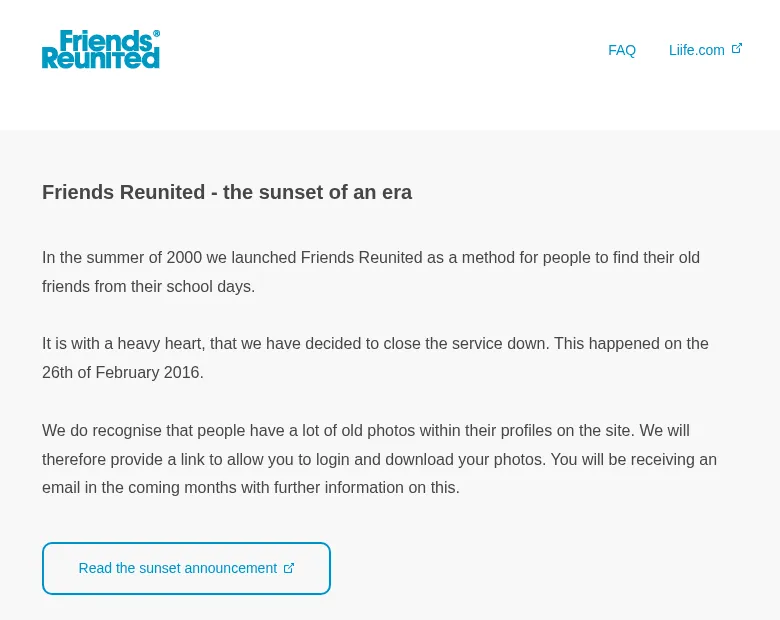
When the site closed, the accounts closed with it. The page that replaced the whole site said plainly that members could no longer log in, because “the FriendsReunited servers have been shut down”.
The one thing the founders promised to hand back was photos. Members were told they’d get an email with a link to log in and download the pictures from their profiles. By the following year the page had changed: the emails had stopped, and anyone who still wanted their photos had to email the Liife support team with their old Friends Reunited login, a service offered “for the remainder of 2016”.
Nothing else was offered back. But some of the site didn’t vanish, thanks to ArchiveTeam, the volunteers who rush to copy websites before they close. Between 5 and 26 February 2016 they downloaded more than 300 GB of Friends Reunited: almost all the groups, some of the discussions and at least the first page of every discussion thread. They say it can be browsed in the Wayback Machine, under friendsreunited.co.uk addresses. It isn’t a complete copy, and it’s the public chatter rather than anyone’s private account. We found nothing to suggest the member database itself was ever published or sold on.
Can I still access Friends Reunited?
Not the site itself. Nobody’s been able to use it since 26 February 2016, and the photo download was only offered until the end of 2016. If you were a member and never got your pictures out, there’s no official way we know of to get them back now. What you can still reach is ArchiveTeam’s copy of the groups and discussions in the Wayback Machine, which is as close as anyone can get to wandering the old corridors.
Is Friends Reunited still going?
No. The closure notice stayed up for a couple of years, but the address has changed hands since: by June 2021 it was showing the website of an IT consultancy in Sweden. Whatever you find at that address now isn’t the Friends Reunited you remember, so don’t type an old password into anything there.
What the founders made is everywhere, though. A site where you put your name against your old school and waited to see who turned up was the UK’s first mass-market social network. The rest of the Messenger Years took that idea and ran with it, and you can follow the same rise and fall at what happened to Bebo and what happened to MySpace.
Friends Reunited timeline
- July 1999: Julie Pankhurst, pregnant with her first child, has the idea.
- February 2000: Steve Pankhurst and Jason Porter form HappyGroup to try out internet ideas.
- July 2000: Friends Reunited goes live from the Pankhursts’ spare bedroom in Barnet.
- December 2000: a new design and logo; about 3,000 members.
- January 2001: Website of the Day on Steve Wright’s Radio 2 show crashes the single server.
- Early 2001: a £5 fee to send messages comes in; browsing stays free.
- August 2001: more than a million members.
- November 2001: the teacher memory boards come down for a while after complaints.
- February 2002: workplaces are added.
- November 2002: the family-tree site GenesConnected launches.
- February 2003: a new management team takes over the day-to-day running.
- December 2005: ITV buys Friends Reunited for £120 million, with up to £55 million more on targets.
- 2008: the fee to contact members is dropped.
- August 2009: ITV agrees to sell it to DC Thomson’s brightsolid for £25 million; the sale completes in 2010.
- 2012: DC Thomson relaunches it as a memories and photos site.
- February 2014: Steve Pankhurst and Jason Porter take back control.
- January 2016: the founders announce the closure.
- 5 to 26 February 2016: ArchiveTeam volunteers copy more than 300 GB of the site.
- 26 February 2016: Friends Reunited closes.
- End of 2016: the last chance to download your photos.

Sources
Each link opens a saved copy in the Internet Archive’s Wayback Machine, in a new tab, as the page was when we read it.
- About FriendsReunited: the story so far, by Steve Pankhurst (Friends Reunited, captured October 2003)
- Friends Reunited home page (captured October 2003)
- Friends Reunited user in libel payout (The Register, 21 May 2002)
- ITV acquires Friends web site for 120 million pounds (informitv, 6 December 2005)
- ITV swallows Friends Reunited (The Register, 6 December 2005)
- ITV 'could dump' Friends Reunited (The Register, 16 February 2009)
- Newspaper publisher buys Friends Reunited (HoldtheFrontPage, 6 August 2009)
- Friends Reunited...reunited: Britain's 'Facebook precursor' is back with the original founders (The Next Web, 16 May 2014)
- Friends Reunited closes, years after everyone thought it was already gone (City AM, 19 January 2016)
- Founders pull plug on 'out of date' Friends Reunited (Decision Marketing, January 2016)
- The end of Friends Reunited (The Barnet Society, 21 January 2016)
- Friends Reunited: the sunset of an era (Friends Reunited, captured March 2016)
- Friends Reunited: the sunset of an era, later version (Friends Reunited, captured December 2017)
- Friends Reunited (ArchiveTeam wiki, captured September 2026)
- friendsreunited.co.uk showing an unrelated company's website (captured June 2021)
From the museum
