

BackRub: Google before it was Google
 By Obscure Internet
 7 min read
Google was originally called BackRub. Larry Page and Sergey Brin, two PhD students at Stanford University, started building it in 1996 and named it after what made it different: it counted the “back links” pointing at each page to work out which pages mattered. In 1997 they renamed it Google, and in September 1998 it became a company, working out of a garage in Menlo Park.
So if you’ve ever wondered what Google was called before it was Google, the answer is a slightly awkward name for a massage. This is the story of how a search engine run from a dorm room, on borrowed computers, got the name it has now, and what it looked like when hardly anyone had heard of it.
What was BackRub?
BackRub was a research project in Stanford’s computer science department. Google’s own account says Page and Brin met in 1995, when Page was visiting Stanford as a prospective graduate student and Brin, already a student there, was one of those showing him round. They argued about nearly everything. By January 1996 they were working together on a search engine.
From the museum

Most search engines of the mid-nineties ranked a page by looking at the words on it. That was easy to fool: stuff a page with popular words and up it went. Page and Brin looked at the links instead. If lots of pages linked to a page, it was probably worth reading, and if the pages linking to it were themselves well linked, even more so. Their search engine analysed those incoming links, the “back links”, and that’s where the name came from.
The idea became PageRank. Their 1998 paper explains it with a “random surfer”, someone who clicks from link to link at random and every so often gets bored and jumps somewhere new. The pages that surfer keeps landing on are the ones that matter.
How did BackRub run on a student budget?
On whatever they could find. Page, who’d already earned a reputation for building a working printer out of Lego, wanted to run the search engine on lots of cheap PCs rather than one big, expensive machine. According to Google’s 2004 history, the pair took to hanging around the computer science department’s loading docks, looking for newly delivered computers they could borrow.
By the first half of 1998 they’d bought a terabyte of disks at bargain prices, built their own computer housings, and turned Page’s dorm room into Google’s first data centre. They paid for it by maxing out their credit cards. Even the first server case was famously unconventional: Google still mentions that it was made of Lego.
It was a lot of hardware for two students, and it had to be. Their paper says that in 1994 one of the first web search engines, the World Wide Web Worm, indexed 110,000 pages. By November 1997 the biggest search engines claimed up to 100 million. Page and Brin expected a billion by 2000.
Why was BackRub renamed Google?
Because they wanted a name that sounded big. David Koller, who worked alongside them in Stanford’s Gates Computer Science Building, wrote down how it happened, from the people in the room. One day in September 1997, Page and his officemate Sean Anderson were at a whiteboard, trying to think of a name to do with indexing a vast amount of data.
Anderson suggested “googolplex”. Page shortened it to “googol”, the number written as a 1 followed by a hundred zeros. Anderson checked whether the domain was free, but he typed it as “google.com”. It was available. Page liked it, and within hours he’d registered google.com for himself and Brin. The registration is dated 15 September 1997.
So the most famous name on the internet is, by this account, a typo that stuck. The founders’ own paper puts it more grandly: they chose the name “because it is a common spelling of googol”, which they said “fits well with our goal of building very large-scale search engines”.
What did Google look like in 1998?
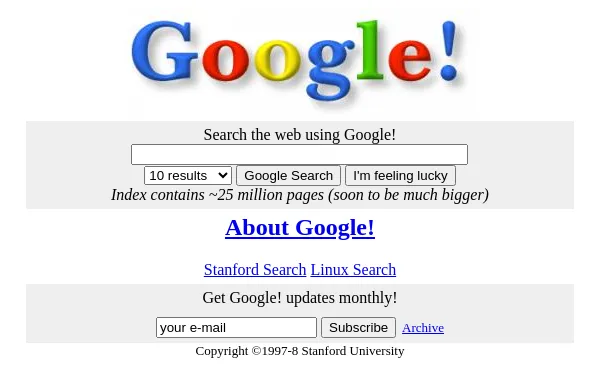
Remarkably bare. The research prototype lived at google.stanford.edu, and in November 1998 its front page was the colourful logo, complete with an exclamation mark that looked a lot like Yahoo!’s, a search box, and the line “Index contains ~25 million pages (soon to be much bigger)”. It was still marked “Copyright ©1997-8 Stanford University”. There was already an “I’m feeling lucky” button.
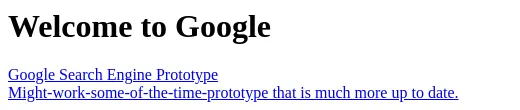
Over at google.com, things were even simpler. The page said “Welcome to Google” and offered two links. One was the Google Search Engine Prototype. The other was, word for word, a “Might-work-some-of-the-time-prototype that is much more up to date.”
If you used the web in 1998, you were far more likely to be typing into AltaVista, Excite, Yahoo! or Ask Jeeves. Their paper notes that in November 1997 AltaVista said it was handling about 20 million searches a day. By September 1998, Google, still in beta, was answering around 10,000.
Did Google try to sell BackRub?
Yes, and nobody bit. Google’s 2004 history says Page and Brin spent the first half of 1998 calling on companies that might license their technology. They had little interest in starting a company of their own. Yahoo! co-founder David Filo told them the technology was solid, but encouraged them to grow it themselves: “When it’s fully developed and scalable, let’s talk again.” Another portal’s chief executive was blunter: “As long as we’re 80 percent as good as our competitors, that’s good enough. Our users don’t really care about search.”
That turned out to be one of the worst predictions of the dot-com years.
How did Google become a company?
With a cheque nobody could cash. In August 1998, Andy Bechtolsheim, a co-founder of Sun Microsystems, met Page and Brin early one morning on the porch of a Stanford professor’s house in Palo Alto. In Brin’s telling, Bechtolsheim saw a quick demo, had to rush off, and said, “Instead of us discussing all the details, why don’t I just write you a check?” It was for $100,000, made out to Google Inc.
There was a small problem: Google Inc. didn’t exist yet. The cheque sat in Page’s desk drawer for a couple of weeks while they set up a company and raised more money from family and friends, almost $1 million in all. Google’s filing with the US Securities and Exchange Commission records that it was incorporated in California in September 1998.
Where was Google’s garage?
In Menlo Park, California, and it belonged to Susan Wojcicki, who became Google’s 16th employee and, years later, ran YouTube. On 7 September 1998, Google Inc. opened its door there. The door came with a remote control, because it was a garage door. The office had a washer and dryer and a hot tub, and room for a staff of three, including the first hire, Craig Silverstein.
Google remembers the clunky desktop computers, a ping pong table and bright blue carpet. By the end of 1998, PC Magazine had named Google one of its top 100 websites and search engines of the year. In February 1999 it moved to an office on University Avenue in Palo Alto, and on 21 September 1999 the beta label finally came off.
Did the founders want adverts on Google?
Not in 1998. The appendix to their Stanford paper is titled “Advertising and Mixed Motives”, and it’s quite something to read now. In it they argue that they “expect that advertising funded search engines will be inherently biased towards the advertisers and away from the needs of the consumers.”
Within a few years Google was making its money from keyword adverts, and you know how that story went. BackRub, the student project, never had to make that choice.
BackRub to Google: a timeline
- 1995: Larry Page visits Stanford; Sergey Brin shows him round.
- January 1996: Page and Brin are working together on BackRub, a search engine that ranks pages by their back links.
- September 1997: BackRub gets a new name. google.com is registered on 15 September.
- 1998: Their paper, “The Anatomy of a Large-Scale Hypertextual Web Search Engine”, describes Google at google.stanford.edu, with at least 24 million pages.
- August 1998: Andy Bechtolsheim writes a $100,000 cheque to a company that doesn’t exist yet.
- September 1998: Google is incorporated in California, and on 7 September opens in Susan Wojcicki’s garage in Menlo Park.
- November 1998: google.stanford.edu promises an index “soon to be much bigger”. google.com offers a prototype that “might work some of the time”.
- 21 September 1999: Google drops the beta label.
Why it still matters
BackRub is a reminder that the web’s biggest names started as somebody’s side project, with a silly name, borrowed computers and a homepage held together with hope. The same years gave us GeoCities and a butler who answered questions, and most of them didn’t survive. One student project with a typo for a name became the way most of us find anything at all.
There’s more from the same years in The Dial-up Years.
Opens in a new tab
Sources
Each link opens a saved copy in the Internet Archive’s Wayback Machine, in a new tab, as the page was when we read it.
- Google history (Google Corporate Information, 2004, archived)
- From the garage to the Googleplex (Google, Our story)
- The Anatomy of a Large-Scale Hypertextual Web Search Engine, by Sergey Brin and Lawrence Page (Stanford, 1998)
- Origin of the name Google, by David Koller (Stanford, January 2004)
- Google Inc. Form S-1 registration statement (US Securities and Exchange Commission, April 2004)
From the museum
