

What happened to GeoCities?
 By Obscure Internet

 8 min read
GeoCities closed on 26 October 2009. Yahoo had bought the free web host ten years earlier for about $3.57 billion in shares, watched its traffic drain away to blogs and social networks, and finally switched it off, taking millions of homemade websites with it. Not everything was lost: volunteers spent the last six months copying as much as they could, and a good deal of it can still be visited today.
If you were online in the late nineties, there’s a fair chance you had a page there. If you didn’t, you certainly visited one: a black background, a spinning email icon, a MIDI file you couldn’t turn off, and a sign promising the page was “under construction”. This is the story of where all of that went.
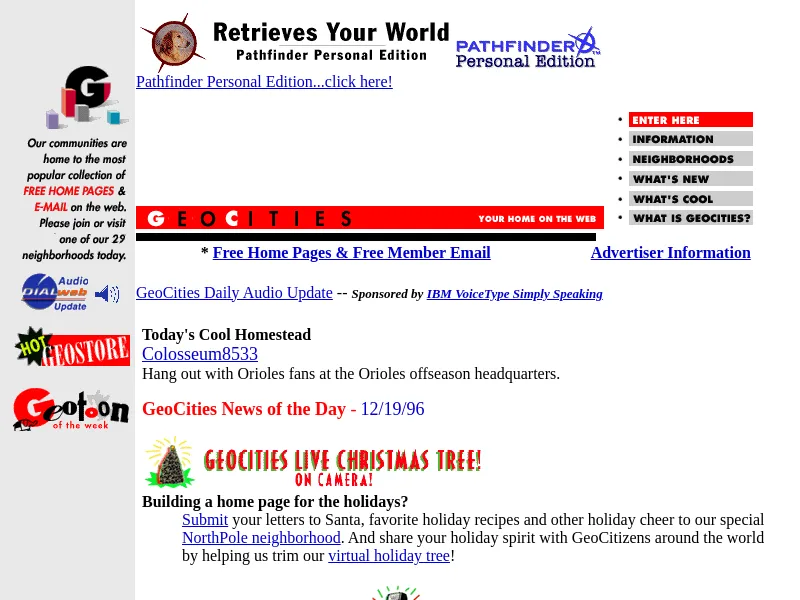
What was GeoCities?
GeoCities was one of the first places where anyone could build a website for free. David Bohnett and John Rezner started it in November 1994 as Beverly Hills Internet, a small hosting company in southern California. In 1995 it began offering free home pages, with a megabyte or two of space, to anyone who signed up. It called them “homesteaders”, and it meant it.
From the museum

The big idea was that the web should feel like a place. Instead of a bare address, you chose a neighbourhood that suited your interests and moved in. Your page got a street number, and your address read like a postal one: geocities.com/Area51/1234. By December 1995 the company had renamed itself after the idea. GeoCities: cities you could live in, all of them on the web.
You didn’t need to know HTML. You didn’t need money. You needed an idea, a free afternoon, and a tolerance for animated GIFs that most of us, it turns out, had in abundance.
How did the GeoCities neighbourhoods work?
Most neighbourhoods were named after a real place that matched their theme. Hollywood was for film and television. SiliconValley was for computers. CapitolHill was for politics, Paris for romance and poetry, and Area51 for science fiction and fantasy. By the end of 1996 there were 29 of them. By January 1998 the directory listed 40, running from Area51 to Yosemite (hiking and the great outdoors) by way of NapaValley (food and wine), MotorCity (cars) and TimesSquare (computer and video games).
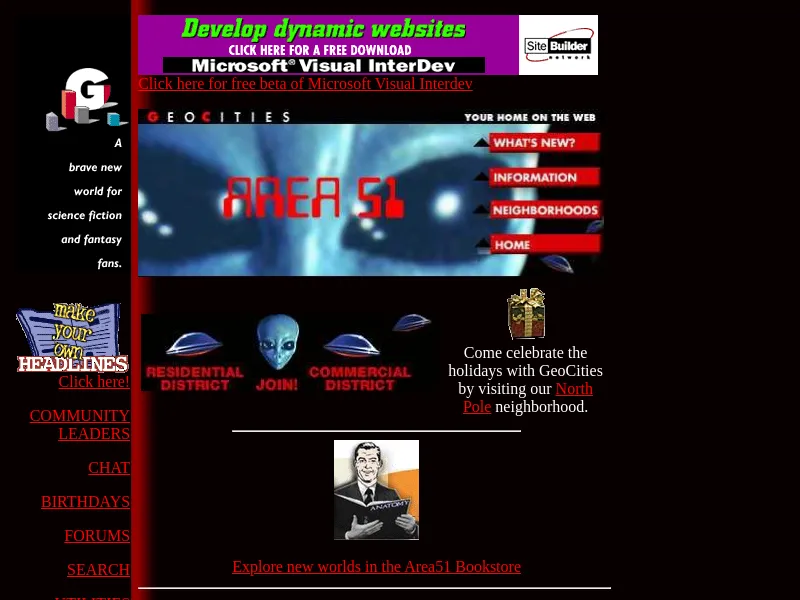
Each neighbourhood had volunteer community leaders, who were meant to spot pages that strayed off theme, along with its own chat rooms, forums and front page. Plenty slipped through anyway. A “Hollywood” homestead could just as easily be a student’s page about their cat, and many were. Area51’s 1996 front page, above, pairs flying saucers with a banner for Microsoft Visual InterDev, which is about as 1996 as a sentence can get.
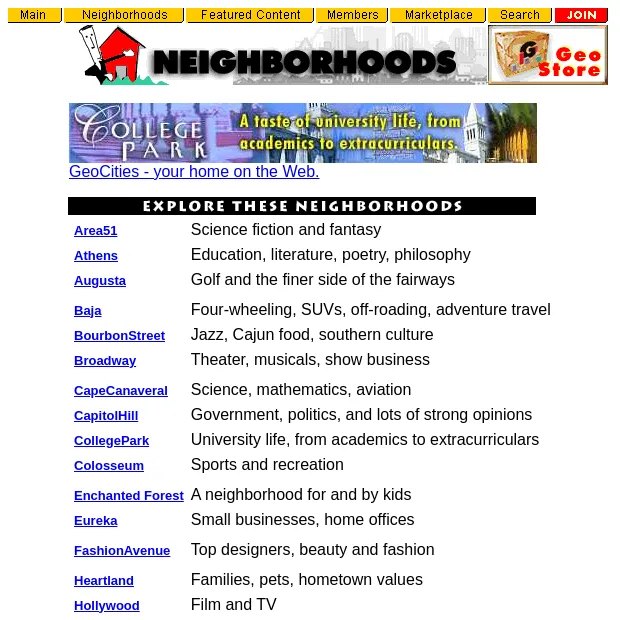
The neighbourhoods gave GeoCities something the rest of the web lacked: a sense of who lived next door. Before search engines were any good, you found new pages by wandering up the street, or by following a webring from one fan site to the next.
How big did GeoCities get?
Very big, very fast. GeoCities floated on the Nasdaq in August 1998 under the ticker GCTY. Its shares were priced at $17, above the expected range, the night before they started trading. A month earlier it had raised every free homestead to 11 MB of space, and it counted 1.9 million members.
When Yahoo agreed to buy it in January 1999, Yahoo’s own press release counted more than 3.5 million sites “authored and hosted on GeoCities” and, using December 1998 figures, put it among the three most visited sites on the web.
Not every homesteader loved the landlord. In June 1998 GeoCities added a translucent logo, a “watermark”, that floated in the corner of every member’s page. On a dial-up connection it slowed pages down, it sat on top of carefully arranged designs, and members protested loudly. It was an early sign of a problem the company never solved: the pages were what people came for, and the people who made them had no say in how they were dressed.
Why did Yahoo buy GeoCities?
Yahoo wanted the audience. On 28 January 1999, at the height of the dot-com boom, it announced it would pay 0.3384 of a Yahoo share for every GeoCities share. At Yahoo’s closing price the day before, that valued the deal at roughly $3.57 billion. It took control at the end of May 1999.
It didn’t take long to upset the residents. On 25 June 1999 Yahoo posted new terms of service that gave it a licence to use members’ content in any way it wished, with no royalties for the people who made it. Homesteaders organised a boycott, and some stripped their pages bare in protest. Within a week Yahoo backed down. Its revised terms, posted on 30 June, said explicitly that it didn’t own or control what members published.
Later that summer the neighbourhoods themselves went. New addresses used your Yahoo member name, geocities.com/yourname, instead of a street number in Area51. The street map that had made GeoCities feel like a city quietly stopped mattering.
When did GeoCities close?
GeoCities closed on 26 October 2009, after a long, slow decline. Through the 2000s, people who wanted to publish something moved to blogs, then to MySpace, then to Facebook. Those were easier to use, and they came with an audience. A GeoCities page needed somebody to stumble across it.
The numbers told the story. According to comScore, GeoCities had 18.9 million unique visitors in the US in October 2006, 15.1 million in March 2008, and 11.5 million in March 2009.
On 23 April 2009, with very little fanfare, Yahoo posted a notice on its help pages. GeoCities would close “later this year” and would take no new sign-ups. Members were nudged towards Yahoo’s paid hosting. That summer Yahoo set the date: 26 October 2009. Archive Team, who were watching closely, report that the switch-off actually came around 12:30pm Pacific time on 27 October, and that a few pages lingered for days afterwards.
Was GeoCities saved?
Partly. The Internet Archive had been capturing GeoCities pages for years, and volunteers moved fast to fill the gaps. Within days of Yahoo’s notice, the archivist Jason Scott had rallied a group called Archive Team to download as much of GeoCities as it could before the deadline. Yahoo wouldn’t provide a list of members’ sites, so the team probed for pages with automated scripts for six months. Scott later compared it to “running through a burning building and deciding what to save”.
They weren’t alone. The Internet Archive ran its own GeoCities project, and independent efforts such as Reocities, OoCities and GeoCities.ws mirrored what they could. Reocities alone claimed around a million accounts.
A year after the closure, at the end of October 2010, Archive Team released its haul to the public as a single torrent: about 642 GB compressed, unpacking to 909 GB. Artists and researchers have been sifting through it ever since. Scott’s own exhibit from the rescued files, “This Page Is Under Construction”, is nothing but hundreds of under construction GIFs, one after another.
Is GeoCities still open anywhere?
No. GeoCities Japan, run as Yahoo! GeoCities since 2000, outlived the original by almost ten years. On 1 October 2018 it announced that it would close at the end of March 2019. Its farewell page thanked everyone who had ever built a homepage there, remembered the old street names and house numbers, and apologised that its own visitor counter had stopped working. You couldn’t have written a more GeoCities goodbye.
Can you still see old GeoCities pages?
Yes, many of them. The easiest way is the Internet Archive’s Wayback Machine at web.archive.org. Type in an old GeoCities address, including the neighbourhood and street number if you remember them, and pick a date. The three artefacts in this exhibit came from there. Old geocities.com addresses themselves now send you to Yahoo’s home page, so the archives are the way back.
The volunteer mirrors, such as OoCities, still hold copies too, though they come and go. If you’re looking for a page you made yourself, Archive Team’s GeoCities wiki page explains how to search the rescued files.
GeoCities: a timeline
- November 1994: David Bohnett and John Rezner start Beverly Hills Internet.
- 1995: Free “homesteads” for anyone who signs up. In December the company renames itself GeoCities.
- December 1996: 29 neighbourhoods. By January 1998 there are 40.
- June 1998: The floating watermark arrives, to members’ fury.
- 10 August 1998: Shares are priced at $17 for the Nasdaq listing, ticker GCTY.
- 28 January 1999: Yahoo announces the takeover, valued at about $3.57 billion.
- 25 to 30 June 1999: The terms of service row, and Yahoo’s climbdown.
- 23 April 2009: Yahoo says GeoCities will close and stops new sign-ups.
- 26 October 2009: GeoCities closes in the US.
- October 2010: Archive Team releases its rescued copy as a 642 GB torrent.
- 31 March 2019: GeoCities Japan’s last day.
Why it still matters
GeoCities was where millions of people first discovered they could publish anything at all. The pages were clumsy, loud and often abandoned once the novelty wore off, and that was the point. Most were made for friends, fans and fellow hobbyists, not for an algorithm. People made things because they could, and then they told their friends to sign the guestbook.
This museum is built in that spirit. Our hit counter counts, our guestbook is real, and it would be lovely if you signed it. There’s more from the same years in The Dial-up Years, including what happened to Ask Jeeves, the butler who helped you find all those homepages.
Opens in a new tab
Sources
Each link opens a saved copy in the Internet Archive’s Wayback Machine, in a new tab, as the page was when we read it.
- Yahoo! buys GeoCities (CNNfn, 28 January 1999)
- Yahoo! To Acquire GeoCities (Yahoo press release, 28 January 1999, archived)
- GeoCities Debuts Redesigned Interface (InternetNews, 6 July 1998)
- Internet Market Close Report for 1998.08.10 (InternetNews)
- Yahoo! Revises GeoCities Terms; Many Call for More (InternetNews, 1 July 1999)
- Yahoo Quietly Pulls The Plug On GeoCities (TechCrunch, 23 April 2009)
- GeoCities (Archive Team wiki)
- GeoCities lives on, sort of (Computerworld, 1 November 2010)
- Yahoo! GeoCities Japan closure notice (Yahoo Japan, 1 October 2018, in Japanese)
- 15 Megabytes of Fame: The GeoCities Story (Mental Floss)
- GeoCities (Wikipedia)
From the museum
