

Webrings: how we found websites before Google
 By Obscure Internet

 7 min read
A webring was a loop of websites about the same thing, joined by a little navigation bar at the bottom of every page: Previous, Next, Random and List. Click Next enough times and you’d travel through every site in the ring and end up back where you started. Before search engines were any good, that’s how a lot of us found the rest of the web.
If you had a fan page in the late nineties, there’s a fair chance you joined one. Your page about Scottish terriers, or Babylon 5, or your favourite band would carry a slightly wonky banner with arrows on it, and that banner was a promise: there are more people like you, and they’re just one click away.
What was a webring?
A webring was a hand-made way of grouping websites. Somebody, the “ringmaster”, chose a topic and agreed to look after the ring. Other people with sites on that topic asked to join. Once they were in, they pasted a bit of code onto their page, and the ring’s bar appeared.
From the museum

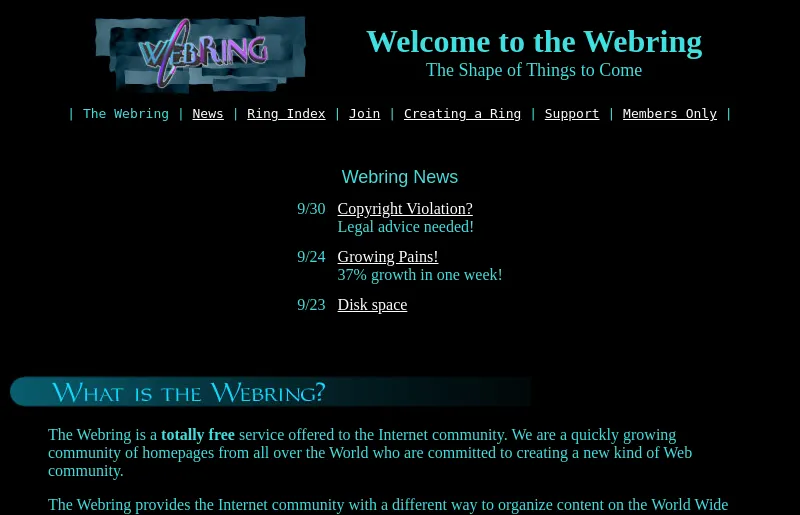
The bar did a few simple things. Next and Previous took you to the neighbouring sites in the loop. Random dropped you somewhere in the ring at random. List showed every member at once. Sage Weil, who built the software most rings ran on, described it on his home page in 1996: you could travel a ring in either direction, skip a site, see the next five sites, jump to a random one, or simply get a list of everything in the loop.
It worked because a person had chosen every site. A search engine in 1997 gave you thousands of results and very little idea which ones were any good. A webring gave you forty pages that somebody who cared about the subject had already looked at.
That somebody was the ringmaster, and plenty of them took the job seriously. A ringmaster decided which sites got in, checked that each one was really about the topic, and quietly dropped sites that had vanished or gone off the rails, so the loop never led you to a dead end. It was unpaid, often fussy work, and a great many people did it for fun, some of them for dozens of rings at once.
Who invented the webring?
The idea came from a British computer scientist, Denis Howe, who started a chain of pages called EUROPa at Imperial College London on 22 December 1994, “just to see how far it would spread”. EUROPa stood for Expanding Unidirectional Ring Of Pages, and it ran entirely by hand. To join, you copied the HTML of the page before yours, filled in your own details, and swapped “Next” links by email with your neighbours. You could join only once, and when a newcomer sent you their address, you followed the links back round to your own page to check they weren’t already in it.
Howe’s page still exists, and it still links to webring.com, under the label “A business inspired by EUROPa!”
The business was the work of Sage Weil, an Oregon teenager. In 1995, aged 17, he built his first ring, inspired by EUROPa, and then solved its biggest problem. In a hand-built ring, every time a site joined or disappeared, somebody had to edit their page, and one dead site broke the circle. Weil moved the links to a central script, so the code on your page never changed and a dead site could simply be skipped. His 1996 home page put the case plainly: “After all, endless pages of links and search engine results are only so interesting.”
How big did webrings get?
Enormous, for something run by volunteers. Weil’s own news page in September 1996 announced “Growing Pains! 37% growth in one week!” According to Salon, there were more than 1,000 rings within a year of the service taking off, more than 10,000 by May 1997, 40,000 by April 1998 and 80,000 by January 2000.
The rings themselves were gloriously specific. Salon found one with 96 sites about Scottish terriers. Weil’s 1996 page listed topics “from Star Wars to Egyptology”. Quake clans had a ring, and a great many rings were full of GeoCities homepages, some carrying banner after banner at the bottom like badges on a denim jacket.
Why did Yahoo end up owning WebRing?
By 1997 the service had outgrown one young man’s spare time, and the servers couldn’t keep up, so Weil sold WebRing to Starseed, a small company in Ashland, Oregon.
Then the dot-com boom picked it up and carried it off. On 11 November 1998, GeoCities agreed to buy Starseed. At the time WebRing had 66,000 rings and more than 900,000 member sites. GeoCities paid 775,000 shares and $2 million in cash, which, at GeoCities’ share price, valued what had started as a high school project at about $30 million.
Barely two months later, in January 1999, Yahoo agreed to buy GeoCities, and WebRing came along in the box.
What did Yahoo do to WebRing?
On 5 September 2000, Yahoo relaunched the service as Yahoo! WebRing. Ringmasters called it “Black Tuesday” and “The Day the Rings Died”.
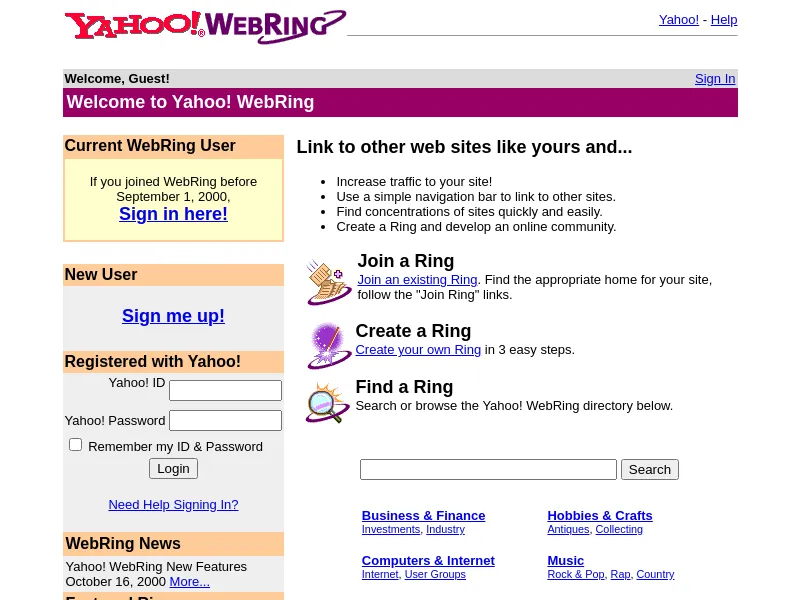
The new system made it easier for beginners to start a ring, but it took power away from the people who’d built them. Signing in now meant a Yahoo ID. The navigation bar now sent visitors through Yahoo’s own hub pages rather than the ringmaster’s home page, which made sense for Yahoo, since those were pages it could put adverts on. Ringmasters who complained got form letters.
They protested in the most webring way possible: they built protest sites and linked them together with a ring hosted on Yahoo’s own WebRing. Some packed up and moved to rival services such as RingSurf, which split a lot of rings in two.
It didn’t last. In April 2001 Yahoo laid off most of the WebRing staff, and in October 2001 it sold the service to Tim Killeen, one of the original Starseed engineers, who carried on running it independently.
Why did webrings die out?
Mostly because search got good. Google arrived in 1998, and by the early 2000s you could type “Scottish terrier” into a search box and get decent results in a second. A ring of 96 terrier sites was charming, but it was no longer the quickest way to find one.
The way people published changed too. Blogs linked to each other directly, and then social networks put everyone on the same site, where a friend’s page was always one click away without anyone running a ring. The big WebRing service carried on for years, but by 2020 webring.com itself had gone dark.
Are webrings coming back?
Yes, in a small and lovely way. Over the last few years, people who miss the old web have been building personal sites again, often on Neocities, and linking them with brand-new webrings. The Debrief wrote about the trend in 2021, describing rings such as the LowTech webring, which its members compared to wandering through a neighbourhood.
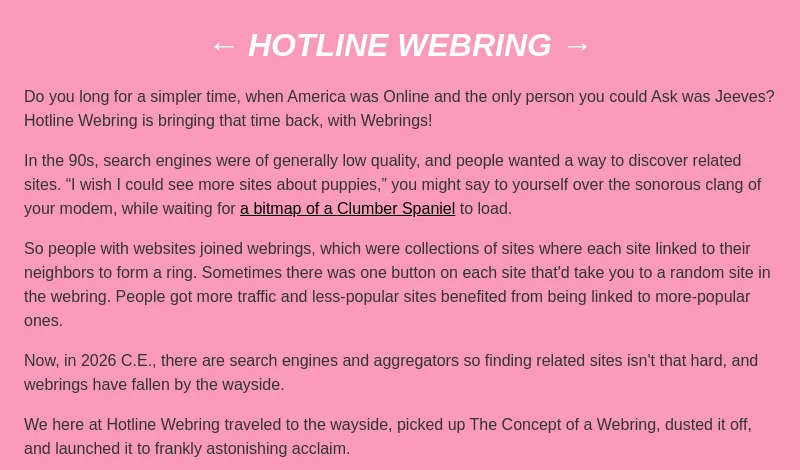
Many modern rings are run by one person with a bit of code and no business plan at all, which is exactly how the first ones started. Hotline Webring, for instance, lets you join by picking a short name and adding Previous and Next links to your site. Its home page opens by asking whether you long for a simpler time, “when America was Online and the only person you could Ask was Jeeves”. If you do, we’ve got an exhibit on him.
This museum has a webring bar of its own at the bottom of every page: Prev, Random, Next and List will walk you round all our exhibits, one homepage-style hop at a time. The “I miss webrings” badge on our front page means it. Our Surprise Me button is really a webring’s Random link with ambitions: one click, and a hand-picked old site you’ve never seen.
Webrings: a timeline
- 22 December 1994: Denis Howe starts EUROPa at Imperial College London.
- 1995: Sage Weil, 17, builds his first ring and the software that runs it.
- September 1996: Weil’s Webring reports 37% growth in a week.
- May 1997: more than 10,000 rings.
- 1997: Weil sells WebRing to Starseed in Ashland, Oregon.
- 11 November 1998: GeoCities agrees to buy Starseed: 66,000 rings and more than 900,000 member sites.
- January 1999: Yahoo agrees to buy GeoCities, and WebRing with it.
- 5 September 2000: Yahoo! WebRing launches. Ringmasters call it “Black Tuesday”.
- April 2001: Yahoo lays off most of the WebRing team.
- October 2001: Yahoo sells WebRing to Tim Killeen, one of its original engineers.
- By 2020: webring.com goes dark.
- 2020s: hand-run webrings return on personal sites.
There’s more from the same years in The Dial-up Years, including the hit counters that sat just above all those webring banners.
Opens in a new tab
Sources
Each link opens a saved copy in the Internet Archive’s Wayback Machine, in a new tab, as the page was when we read it.
- Denis's EUROPa Page (Denis Howe, FOLDOC)
- The Webring: Home (Sage Weil, October 1996)
- GeoCities to Acquire WebRing (Writers Write, 11 November 1998)
- Welcome to Yahoo! WebRing (Yahoo, November 2000)
- The strange saga of Yahoo and WebRing (Salon, 5 December 2001)
- Webring History: Social Media Before Social Media (Tedium, 20 November 2020)
- Tech Workers Rebel Against a Lame-Ass Internet by Bringing Back GeoCities-style WebRings (The Debrief, 6 September 2021)
- Hotline Webring (home page, October 2026)
- Webring (Wikipedia)
From the museum
