

TheFacebook: the 2004 version
 By Obscure Internet
 8 min read
In 2004, Facebook was called Thefacebook, lived at thefacebook.com, and started out only for students at Harvard. It was a plain blue-and-white directory: a search box, a profile with your classes and your friends, and a little footer that read “a Mark Zuckerberg production”. There was no News Feed, no photo albums and no adverts in your timeline, because there was no timeline. And there was a button called “poke” that even the people who built it couldn’t explain.
It grew so fast that by the end of that first year nearly a million students were on it. This is what it looked like before it was famous, and how it got from one university to everyone.
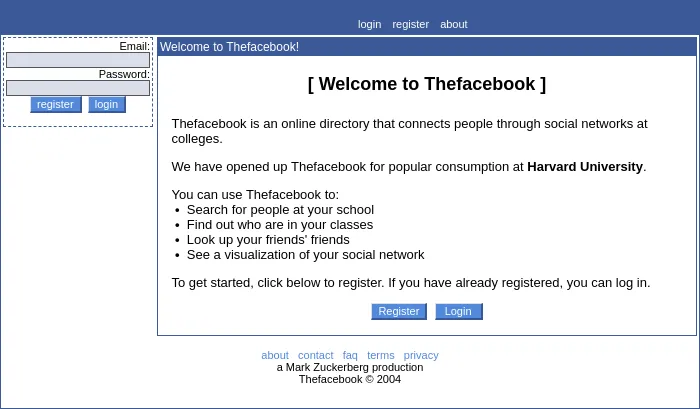
What did Facebook look like in 2004?
Like a university directory that had been given a coat of blue paint. The home page above was captured on 12 February 2004, eight days after launch. A blue bar ran across the top, with a login box on the left and a white panel in the middle. Everything was in small, sensible sans-serif type, with the site’s name in square brackets: “[ Welcome to Thefacebook ]”.
From the museum

Later captures show a banner at the top left, which hasn’t survived in this one: a grainy portrait of a man’s face, built out of ones and zeros. Users nicknamed him the “Facebook guy”, and it wasn’t widely known who he was until 2010, when David Kirkpatrick’s history of the company, The Facebook Effect, revealed him as a manipulated photo of Al Pacino, made by a friend and classmate of Zuckerberg’s.
The pitch was four bullet points. You could use Thefacebook to:
- search for people at your school;
- find out who was in your classes;
- look up your friends’ friends;
- see a visualisation of your social network.
That last one needed a browser plug-in for a graphics format called SVG. The FAQ promised it would install in about 15 seconds, and apologised that the network map was slow and fiddly to move around: “We didn’t make the SVG viewer; we just use it to bring you pretty pictures.”
What was on a Thefacebook profile?
Less than you’d think. A profile came in four parts: your contact information, your personal information, your courses and your friends. You could give each part its own privacy setting, so your classes might be open to your whole year while your phone number stayed with your friends.
Friendship worked the way it still does, mostly. Links were always two-way, so if you removed someone, you disappeared from their list too, and they weren’t told. If you turned down a friend request, the FAQ explained, the other person wasn’t told that either. They just couldn’t ask again for a while, “so to them, it will just seem as if you haven’t confirmed their friendship yet.” Generations of awkwardness were built on that one sentence.
There was also a “social net” page. Click it and the site showed you ten random people from your network whose settings let you see them, limited to people who’d uploaded a picture “to make things more interesting.” In a world before the News Feed, that was how you went browsing.
Why was it called Thefacebook?
Because Harvard students already knew what a face book was. Each of the university’s residential Houses had its own directory of students’ photos and details, and there was talk of the university making one universal version for everyone.
Mark Zuckerberg, then a second-year student, decided not to wait. “I think it’s kind of silly that it would take the University a couple of years to get around to it,” he told the student paper, The Harvard Crimson. “I can do it better than they can, and I can do it in a week.”
He very nearly did. After about a week of coding, he launched thefacebook.com on the afternoon of Wednesday 4 February 2004. Within days, more than 650 students had signed up. Only Harvard email addresses could join, and the site checked that the name you gave matched the address before it let you in. Zuckerberg told the Crimson that the friend-search idea was modelled on Friendster, the social network of the moment.
He also talked up the privacy settings. You could limit who saw your profile to people in your year, your House or your classes, or to your friends and their friends. The Crimson noted why that mattered to him: the previous autumn, a site of his called Facemash, which used students’ photos without permission, had angered students and administrators alike, and he’d shut it down within days.
How did Thefacebook spread beyond Harvard?
One campus at a time, on purpose. Three weeks after launch, Zuckerberg opened it to Columbia on Wednesday 25 February 2004 and to Stanford the next day, and Yale followed on 1 March. He told the Crimson each school took about three hours to set up. The start was modest: students at Columbia and Stanford counted 37 and 26 profiles in those first few days, against 5,055 at Harvard. Each new school got its own custom site before its students could register, and you could only join with an email address from a school on the list. If your college wasn’t there, the FAQ said, it had a plan to add “many new schools to the network over the next year”, and it took suggestions.
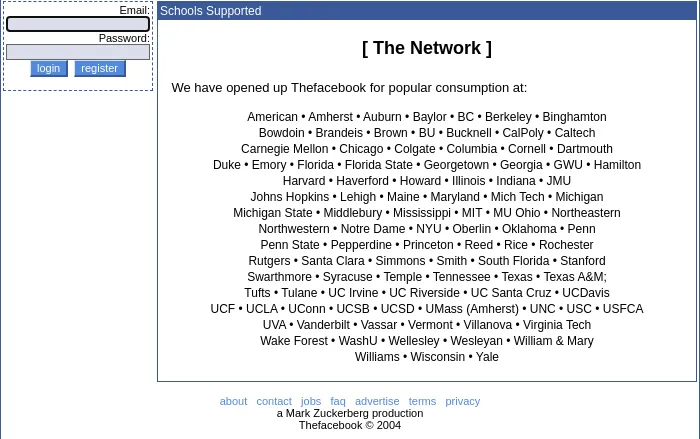
By early September 2004, the “Schools Supported” page listed 99 colleges, from American and Amherst to Williams, Wisconsin and Yale. That summer the company had moved its base to Palo Alto, California. In September it added Groups, and the Wall, a space on your profile where friends could leave messages for others to read. By December, according to Facebook’s own timeline, it had nearly a million active users.
The rationing was half the appeal. When your school finally appeared on the list, it felt like being let into something. If you were at a university that wasn’t on it yet, you heard about it from friends who were.
What was a poke for?
Nobody knew, and that was official. The 2004 FAQ answered the question “What is poking?” like this: “We have about as much of an idea as you do. We thought it would be fun to make a feature that has no specific purpose and to see what happens from there. So mess around with it, because you’re not getting an explanation from us.”
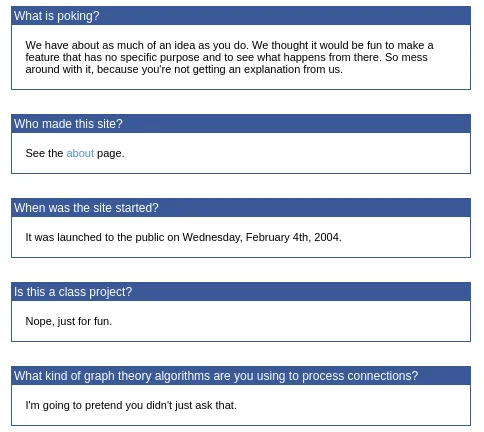
The same FAQ said the site wasn’t a class project (“Nope, just for fun”) and dealt with a question about its graph theory algorithms with “I’m going to pretend you didn’t just ask that.” It’s hard to imagine a company that size writing its help pages like that now.
People worked out uses for the poke on their own: hello, I’m thinking of you, I fancy you, I’m bored. If you were there, you’ll remember the poke wars, where two people poked each other back and forth for weeks because neither would be the one to stop.
When did Thefacebook drop “The”?
In August 2005, Thefacebook officially became Facebook. It had bought the plain facebook.com address that month for a reported $200,000. When the price it paid for fb.com came out in January 2011 (up to $8.5 million), InformationWeek worked out that it was more than 42 times as much, for two letters.
By then the network supported more than 800 colleges. In September 2005 it opened to American high schools, and in October it added photos. By December 2005 it had more than 5.5 million active users.
The profile itself grew a little. Status updates arrived, and for a while every one had to begin with your name and the word “is”, which gave the world updates such as “Sarah is likes to dance”. Statuses that began with “is” were finally made optional in late 2007, after a protest group against the compulsory “is” passed 64,000 members.
When could anyone join Facebook?
On 26 September 2006. Until then, most people had needed a supported college, work, charity, government or military email address (.edu, .com, .org, .gov or .mil) to register. From that day, anyone aged 13 or over with a valid email address could join, and pick from more than 500 regional networks. Zuckerberg said about a third of Facebook’s college users had already graduated by then, so the site was following them out into the world anyway.
The same month, Facebook introduced the News Feed, which put your friends’ updates on one page instead of making you visit each profile. That’s the moment it stopped being Thefacebook in anything but memory. The quiet blue directory, where you looked people up one at a time, had become the place where everything came to you.
Over the next couple of years it would pull people away from Bebo in Britain and Ireland, and give the evening chat on MSN Messenger a rival.
Thefacebook: a timeline
- 4 February 2004: thefacebook.com launches at Harvard after about a week of coding.
- 25 February to 1 March 2004: It opens at Columbia, Stanford and Yale.
- June 2004: The company moves to Palo Alto, California.
- September 2004: Groups and the Wall arrive; the network lists 99 colleges.
- December 2004: Nearly a million active users.
- May 2005: More than 800 college networks.
- August 2005: Thefacebook becomes Facebook, and buys facebook.com for a reported $200,000.
- September 2005: High school networks open.
- October 2005: Photos arrive.
- 26 September 2006: Anyone aged 13 or over with a valid email address can join; the News Feed arrives the same month.
- Late 2007: The compulsory “is” in status updates is dropped.
Before they were famous
Thefacebook is the hardest exhibit in this museum to picture, because the thing it became is everywhere. But in 2004 it was a student project with a joke FAQ, a mystery button and a list of colleges you had to be on to get in. More from the same years waits in The Messenger Years, and more giants in their earliest form in Before They Were Famous.
Opens in a new tab
Sources
Each link opens a saved copy in the Internet Archive’s Wayback Machine, in a new tab, as the page was when we read it.
- Hundreds Register for New Facebook Website (The Harvard Crimson, 9 February 2004)
- Facebook Expands Beyond Harvard (The Harvard Crimson, 1 March 2004)
- 10 Fascinating Facebook Facts (ABC News, 24 July 2010)
- Terms of Use (Facebook, October 2006)
- Welcome to Thefacebook! (thefacebook.com home page, 12 February 2004)
- Thefacebook FAQ (thefacebook.com, September 2004)
- Schools Supported (thefacebook.com, September 2004)
- Company Timeline (Facebook press room, 2007)
- Facebook Expansion Enables More People to Connect with Friends in a Trusted Environment (Facebook press release, 26 September 2006)
- Facebook Paid $8.5 Million For FB.com (InformationWeek, 12 January 2011)
- Facebook drops "is" status updates, poetry dies (Salon, 20 November 2007)
From the museum
