

Minecraft Classic: the browser game that started it all
 By Obscure Internet
 7 min read
The first version of Minecraft was a free game you played in your web browser. Markus Persson, known online as Notch, put the first public test online on 17 May 2009, and anyone could play it straight away, no download and no payment. About a year later he renamed that original version Minecraft Classic, and you can still play it today: a browser remake of it came out in 2019 to mark the game’s tenth birthday.
If you remember Minecraft as the biggest game in the world, this is the bit before that. A one-man project with a website that said “Nothing here yet!”, a game with four kinds of block, and a blog full of ideas typed out late at night.
What was the first version of Minecraft?
It started as a video. On 13 May 2009 Persson uploaded a clip to YouTube called “Cave game tech test”, according to Guinness World Records the first Minecraft video ever posted. The game didn’t have a name yet. It was blocks, a cave, and someone walking around in them.
From the museum

Four days later, on 17 May 2009, he posted on TIGSource, a forum for independent game developers, to announce the first public alpha. Guinness, which keeps a record of this sort of thing, says that within minutes other members were posting pictures and videos of what they’d built and suggesting new features. It’s not a bad description of how Minecraft has worked ever since.
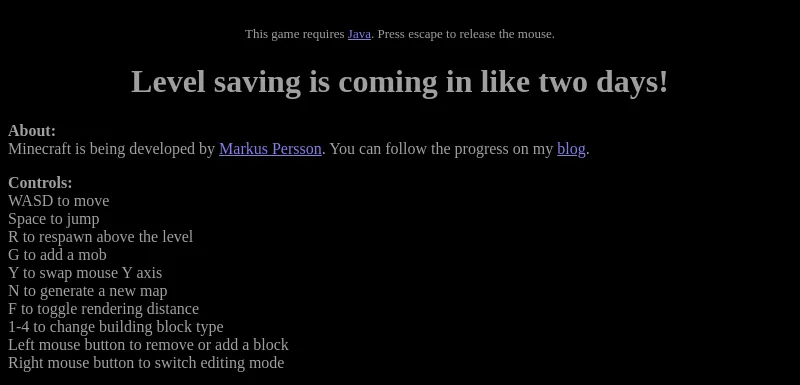
By then the game had its name, and a page to play it on. The controls listed underneath tell you how small it was. WASD to move, space to jump, R to respawn, G to “add a mob”, N for a new map, and “1-4 to change building block type”. Four kinds of block. That was the whole box of bricks.
How did you play Minecraft in a browser in 2009?
The game was a Java applet. That meant a small program that ran inside a web page, through a plug-in in your browser, much as Flash games did. You opened the page, waited while Java woke up, and then you were standing in a world made of blocks. The page’s first line said it plainly: “This game requires Java. Press escape to release the mouse.”
That’s why the archived page above has no game on it. The applet that used to load there can’t run any more. Browsers have since dropped plug-ins altogether, and in January 2016 Oracle, which looks after Java, announced it would deprecate the Java browser plug-in in its next major version, nudging developers to move their applets elsewhere. The original Classic, as it was, can’t run in a modern browser.
What was Minecraft like in its first week?
Busy. Persson kept a blog, The Word of Notch, which described itself as “Opinions, rants, screenshots and demos from an up and coming indie game developer”, and in May 2009 he was posting several times a day.
On 20 May he released version 0.0.12a, which added water, lava and a new level generator, plus a key to make a new world without starting over. He worried in public about water: as it stood, a single block of water high up could flood an entire map. He wondered whether to add health and food. In all modes except creative, he wrote, you’d take damage from falls, lava, fighting and drowning, and you’d eat to recover. That’s more or less how it still works.
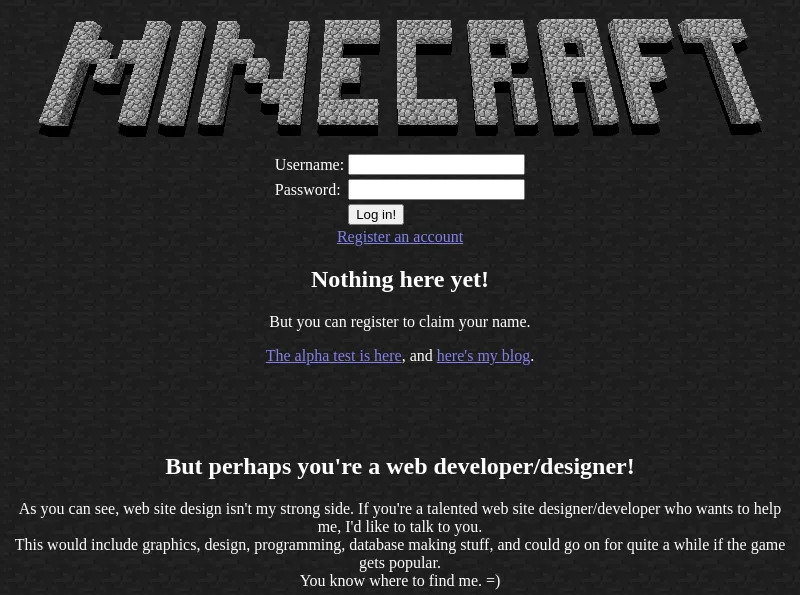
There was no saving yet. The play page promised “Level saving is coming in like two days!”, and on 21 May he opened accounts at minecraft.net, telling players that signing up was simple and free and would be needed for saving. Which brings us back to that front page, five days after the TIGSource post, apologising that “web site design isn’t my strong side” and asking any web designers reading to get in touch.
When did Minecraft get survival mode?
Survival came in as a test. On 19 August 2009 Persson announced that a single-player test of Survival Mode would go up for paying customers on 1 September, just before he left for a three-week sailing holiday. He’d read the feedback when he got back. The original way of playing, building freely, was already being called creative mode.
Yes, paying customers. Even in 2009 you could buy the game while it was still being made. By 3 February 2010 the front page counted 110,822 registered players and 4,239 purchases, and offered a “survival mode” single player test next to creative mode, which you could play alone or with others.
Behind the scenes there was a development version too, called Indev. On New Year’s Eve 2009 Persson added the first inventory screen to it, with two hours and twenty minutes of 2009 left, and asked his readers whether he’d finish non-tile items before midnight.
Why is it called Minecraft Classic?
Because the game moved on without it. By the summer of 2010 the main game had become Minecraft Alpha, a much bigger game with enemies, mining, farming and a huge randomly generated world. On the front page in July 2010, Persson wrote: “I’m renaming the old version of the game ‘Minecraft Classic’, and will be slowly phasing it out. I won’t remove it, though. Just hide it.”
He kept his word. By December 2010 the site described the game as “a game about placing blocks while running from skeletons. Or something like that..”, and listed Classic as the free option next to Alpha. The counter said 2,217,480 people had registered and 687,821 had paid. In July the count had stood at 23,545, so in five months purchases had gone up nearly thirty times.
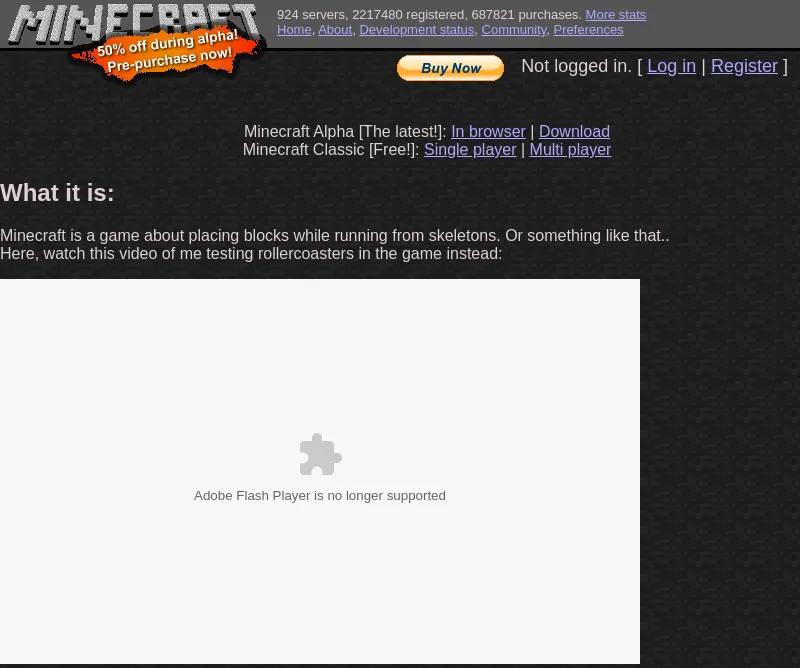
Look at the big grey box on that page. It used to hold a video of Persson testing rollercoasters, embedded with Flash. Now it says “Adobe Flash Player is no longer supported”, which is what the web did to most things from that year.
This was also the season when playground rumours took off. If you remember Herobrine, the ghostly figure everyone’s cousin had definitely seen, he belongs to this era.
When did Minecraft come out properly?
In stages. On 11 December 2010 Persson announced that Minecraft would enter beta on 20 December, with the price going up from 9.95 euros to 14.95 euros. Game Informer pointed out the deal for early buyers: anyone who bought during alpha would get every future update, including the final release, for nothing. On 20 December he posted that he’d updated the client and server to “Minecraft Beta 1.0”.
The full release, version 1.0, came on 18 November 2011 at MineCon, the first official Minecraft convention, held at the Mandalay Bay resort in Las Vegas. By the start of December 2011 the front page said 17,402,918 people had registered and 4,208,316 had bought the game. Classic was still there, now labelled “Outdated, but free”.
What happened to Minecraft after that?
It became one of the biggest games ever made, and its maker was sold. On 15 September 2014 Microsoft announced it would buy Mojang for 2.5 billion dollars, noting more than 100 million downloads of Minecraft on PC alone since its launch in 2009. Mojang’s own announcement said the three founders, Persson among them, were leaving the company.
Can you still play Minecraft Classic?
Yes. On 7 May 2019, ten days before the game’s tenth birthday, Mojang released Minecraft Classic for modern browsers at classic.minecraft.net. It recreates a Classic build from 2009, version 0.0.23a_01, rather than the very first one. It’s free, there’s nothing to install, and it no longer needs Java: the new version runs on WebGL, which modern browsers have built in. The official Minecraft account promised “the original creative mode, complete with 32 blocks and all the beloved bugs!”
It’s a strange, lovely thing to go back to. Just you, a small world and 32 kinds of block. Everything the game later became grew out of that.
Minecraft Classic: a timeline
- 13 May 2009: “Cave game tech test” goes up on YouTube.
- 17 May 2009: Persson announces the first public alpha on the TIGSource forum.
- 20 May 2009: Version 0.0.12a adds water and lava.
- 21 May 2009: Accounts open at minecraft.net, ready for level saving.
- 1 September 2009: A Survival Mode test opens for paying customers.
- 31 December 2009: The development build gets its first inventory screen.
- July 2010: The original version is renamed Minecraft Classic; the main game is now Minecraft Alpha.
- 20 December 2010: Minecraft enters beta.
- 18 November 2011: Minecraft 1.0 is released at MineCon, the first official Minecraft convention.
- 15 September 2014: Microsoft agrees to buy Mojang for 2.5 billion dollars.
- 27 January 2016: Oracle announces it will deprecate the Java browser plug-in.
- 7 May 2019: Minecraft Classic returns, free in the browser.
There’s more from the same years in The Playground Years, and a whole lot more on what became of browser games in what happened to Flash games.
Opens in a new tab
Sources
Each link opens a saved copy in the Internet Archive’s Wayback Machine, in a new tab, as the page was when we read it.
- First online Minecraft video (Guinness World Records)
- First Minecraft-related forum post (Guinness World Records)
- Minecraft (alpha), the first play page (May 2009)
- The Word of Notch, Markus Persson's blog (20 May 2009)
- The Word of Notch, page 4 (27 May 2009)
- Survival Mode test for paid customers coming September 1 (The Word of Notch, 19 August 2009)
- Partial update on /indev/, more to come (The Word of Notch, 31 December 2009)
- minecraft.net front page (3 February 2010)
- minecraft.net front page (2 July 2010)
- Minecraft Entering Beta, Increasing In Price (Game Informer, 11 December 2010)
- Minecraft Beta (The Word of Notch, 20 December 2010)
- First official Minecraft convention (Guinness World Records)
- minecraft.net front page (1 December 2011)
- Minecraft to join Microsoft (Microsoft press release, 15 September 2014)
- Yes, we're being bought by Microsoft (Mojang, September 2014)
- Moving to a Plugin-Free Web (Oracle Java blog, 27 January 2016)
- Minecraft Classic, the 2019 browser version (classic.minecraft.net, May 2019)
- Minecraft Classic hits browsers for 10-year anniversary (Windows Central, 7 May 2019)
From the museum
