

Habbo Hotel: the pixel hotel that never closed
 By Obscure Internet

 8 min read
Yes, Habbo Hotel is still open. The pixel hotel that first opened its doors in Finland in 2000 celebrated its 25th birthday in August 2025, and since June 2024 there’s been a second way in: Habbo Hotel: Origins, a careful recreation of the hotel as it looked in 2005. Plenty of its neighbours from the same years have closed. Habbo just kept the lights on.
If you were a teenager in the 2000s, you’ll remember the rest: a blocky little avatar, a speech bubble with your words in it, a room full of furniture you begged your parents to buy, and a swear filter that turned your best insults into the word “bobba”. Here’s how the hotel got built, what happened to it, and why it’s still standing.
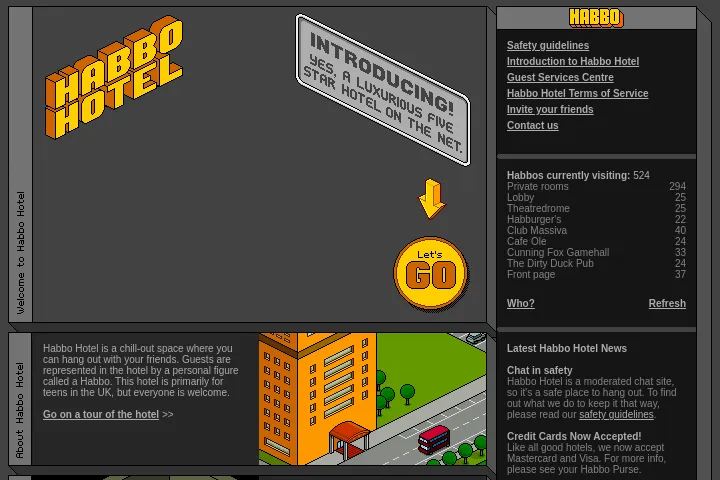
What was Habbo Hotel?
Habbo Hotel was a virtual hotel you could walk around in your web browser. You made a pixel character, called a Habbo, and wandered between public rooms to chat to strangers. The British hotel’s 2001 front page, above, lists a few of them: the Lobby, the Theatredrome, Habburger’s, Club Massiva, Cafe Ole and the Dirty Duck Pub, with a running count of how many Habbos were in each. It also warned that you’d need Macromedia’s Shockwave plug-in to get in.
From the museum

You also had a Guest Room of your own to decorate. That’s where the real game was. Furniture, always called furni, came from an online catalogue and was paid for in Habbo Credits, which you bought with real money: by text message, by phone, by card or with prepaid cards from the shops. Rooms became cafés, clubs, game rooms and quiet places to hang out, and Habbo’s makers once described how players formed posses and ran police departments and hospitals, paying their “workers” in furni.
Everything was drawn in what Sulake, the company behind it, called the “Habbo pixel style”: an angled, isometric world that looked like an early computer game. Everyone was the same height, on purpose, so nobody towered over anyone else.
Where did Habbo Hotel come from?
Habbo started as a hobby. In 1999 two young Finns, Sampo Karjalainen and Aapo Kyrölä, built a small online meeting place for a friend’s band. “It was just a meeting place for the band members and fans which we made for fun,” Karjalainen later told the trade magazine Develop, “but after released it grew hugely popular, and we attracted users from outside Finland and worldwide.”
In 2000 the pair made a snowball-fighting game with text-message payments for a Finnish advertising group’s online arm. They formed Sulake in May 2000, and in August 2000 they opened Hotelli Kultakala, or Hotel Goldfish. It had just four rooms. Sulake’s lead designer Sulka Haro later admitted that the retro pixel look had been aimed at style-conscious twenty-somethings, and that the company was surprised when teenagers moved in instead. The first way to pay for furni was a premium text message from your mobile.
When did Habbo come to the UK?
The hotel soon crossed the North Sea. By the summer of 2001 Habbo Hotel was open on its own UK address, describing itself as “a chill-out space where you can hang out with your friends” and adding that the hotel was “primarily for teens in the UK, but everyone is welcome”. The same page proudly announced that credit cards were now accepted, “like all good hotels”.
By June 2003 there were hotels in Finland, the UK, Switzerland and Japan, more than seven million registered Habbos, and over 700,000 players visiting each month. According to Sulake’s own figures, 80 percent of them were aged between 10 and 18.
What made Habbo so different?
The furni, mostly. It wasn’t just decoration. It was status, currency and a way to show off, and people traded it, gave it away and guarded their rarest pieces. There’s a whole card on Habbo furni and credits if you want to wince at the memory.
Some of the hotel’s best-loved quirks were accidents. Stacked furni floated in mid-air, which started as a bug and was kept because players built such wonderful things with it. Some of the bestsellers were strange, too: at a 2008 games conference, Haro said Habbo had probably sold more virtual reindeer poo than anyone in history, around 70,000 pieces of it.
Then there was the Lido, the pool room, where it cost credits to climb the diving board and other Habbos held up scorecards for your dive. And there was the Bobba Filter. Every line of chat passed through it before it appeared on screen, and anything rude came out as “bobba”. A whole generation learned to swear creatively because of it. Volunteer moderators called Hobbas patrolled the rooms, backed up by Sulake’s paid staff.
What did people actually do in Habbo?
Mostly, they pretended. At the same 2008 conference, Haro said role-play was the main thing people did in Habbo, more than in almost any other game. Players took “jobs” in other people’s rooms, usually for nothing or for a bit of furni, and the hotel filled up with pretend cafés, hospitals, police stations and hotels within the hotel. For a younger teenager it was a way to try being a grown-up from a safe distance. The write-up of his talk summed up the pitch as having your own room and friends who love to hang out at your place, which, at fourteen, plenty of people didn’t have.
There was no voice chat, and that was deliberate too. Sulake kept it out because voice tends to wreck the social side of a game; the write-up of Haro’s talk gave the example of a teenage boy whose voice was breaking. Everything happened in speech bubbles instead, which suited a generation raised on MSN.
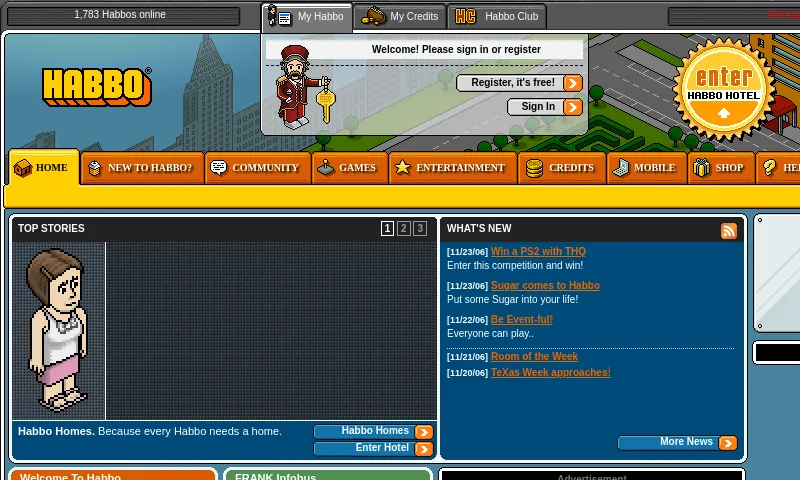
The staff became minor celebrities. Habbo’s 2003 entry for the Ars Electronica prize says players built rooms in their honour and sent them gifts at Christmas and Easter. And by 2006 every Habbo could have a Habbo Home as well, a page of their own on the website. As the site put it: “Because every Habbo needs a home.”
How big did Habbo get?
Very big. In December 2007 alone, 8.3 million different people visited. By February 2008 it counted 89 million accounts across 31 markets, with a peak of around 100,000 people online at once. Much more than that, Haro said, and things started to break. In June 2008 Sulake announced its 100 millionth registered Habbo and said close to 10 million people visited each month.
The money was serious too. Develop reported in 2009 that Sulake’s revenue for 2008 had been around €51 million, that it employed more than 300 people, and that Habbo had around 129 million registered characters, most of them belonging to 12 to 16-year-olds. While Club Penguin courted younger children with safe chat and puffles (that story’s in what happened to Club Penguin), Habbo was where their older brothers and sisters hung out.
What happened to Habbo in 2012?
In June 2012 a Channel 4 News investigation reported sexual chat and weak moderation on a site aimed at children as young as 13. Sulake muted chat across the whole site while it investigated, and the investor Balderton Capital pulled out. Sulake pointed to its 225 moderators and said it would tighten security and its rules.
The hotel survived it. The teenagers who’d made it famous were growing up, though, and the crowds never came back to their 2008 size.
Who owns Habbo now?
Azerion, a Dutch games and advertising company, bought a controlling 51 percent of Sulake in 2018 and agreed to buy the remaining 49 percent from the Finnish telecoms company Elisa in January 2021. At the time, Habbo had around 800,000 monthly active players in 115 countries, a long way from the 10 million monthly visitors of 2008, and Sulake still ran it from Helsinki with a team of 96. By 2020, it had passed 316 million registrations in total.
What is Habbo Hotel: Origins?
In June 2024 Sulake opened Habbo Hotel: Origins, a recreation of the hotel as it existed in 2005. “If you played in 2005, the hotel should feel exactly as you remember it,” the team said, promising “roller stacking, the hand, and sparkly HC badges”, with no newer extras like limited-edition collectibles or NFTs. It’s for players aged 18 and over this time, with hotels for English, Portuguese and Spanish speakers, and players vote on its future in the InfoBus Park room.
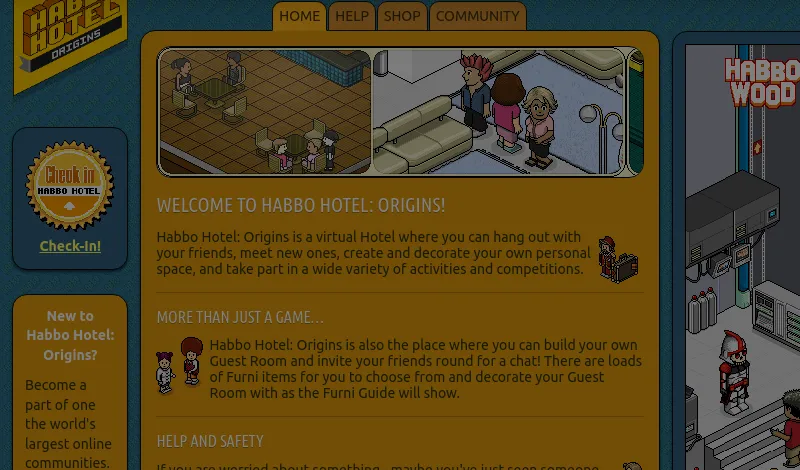
The Lido’s diving board is back, and so are the scorecards.
Is Habbo Hotel still open?
Yes. The main hotel marked its 25th anniversary in August 2025 with a month of events across all nine of its hotels, and Habbo Hotel: Origins was still taking guests in October 2026. Very few hangouts from the early 2000s can say that. GeoCities, MSN Messenger and Club Penguin have all gone, and the museum has exhibits on each of them. Habbo is the one you can still check into.
Habbo Hotel: a timeline
- 1999: Sampo Karjalainen and Aapo Kyrölä build an online meeting place for a friend’s band.
- May 2000: They found Sulake.
- August 2000: Hotelli Kultakala (Hotel Goldfish) opens in Finland with four rooms.
- 2001: Habbo Hotel opens in the UK, “primarily for teens”.
- June 2003: Hotels in Finland, the UK, Switzerland and Japan; more than seven million registered Habbos.
- December 2007: 8.3 million visitors in a month.
- June 2008: The 100 millionth registered Habbo.
- June 2012: A Channel 4 News investigation; Sulake mutes chat across the site.
- 2018: Azerion buys a controlling stake in Sulake.
- January 2021: Azerion agrees to buy the rest.
- June 2024: Habbo Hotel: Origins brings back the 2005 hotel.
- August 2025: Habbo turns 25.
There’s more from the same era in The Playground Years.
Opens in a new tab
Sources
Each link opens a saved copy in the Internet Archive’s Wayback Machine, in a new tab, as the page was when we read it.
- Habbo Hotel (Ars Electronica Prix entry, 2003)
- GDC08: Sulka Haro tells us how to Habbo (Massively, 19 February 2008)
- Habbo likely to take over WoW as number one MMO (The Next Web, 30 June 2008)
- Finland focus: Sulake (MCV/Develop, 7 July 2009)
- Amidst child sex scandal, Habbo mutes its entire site while it investigates (The Next Web, June 2012)
- What is happening in Habbo Hotel? (Channel 4 News, 2012)
- Dutch company Azerion fully acquires the developer of hit social game Habbo Hotel (Silicon Canals, 26 January 2021)
- Azerion Announces Launch of Habbo Hotel: Origins (ExchangeWire, 18 June 2024)
- 2000s MMO Game Habbo Hotel Is Getting A Throwback Revival (Time Extension, June 2024)
- Habbo Hotel: Origins is a wonderful time capsule of nostalgia (GamesHub, 2024)
- Habbo Hotel: Origins (TheSmartLocal, 2024)
- Habbo Marks 25 Years With a Month-Long Global Celebration (COGconnected, August 2025)
- Habbo (Wikipedia)
From the museum
