

What happened to MSN Messenger?
 By Obscure Internet

 9 min read
MSN Messenger closed for most of the world in April 2013, when Microsoft stopped its Messenger program from signing in and moved its users to Skype, the internet phone service it had bought in 2011. China kept it officially until 31 October 2014, and Microsoft’s last Messenger server finally went dark in May 2017. After fifteen years, the little green and blue buddies went quiet.
If you were a teenager in the 2000s, that’s the boring answer. The real one involves a code war with AOL, a window that shook, a generation of song lyrics typed into display names, and a pop-up asking whether you wanted to accept a file called holiday pics.exe (you didn’t).
When did MSN Messenger come out?
Microsoft announced MSN Messenger Service on 21 July 1999, and the download went live at midnight on 22 July. The pitch was simple. You could see when your friends were online and send them messages that arrived instantly, which in 1999 still felt slightly like magic. You signed in with your Hotmail address, and Hotmail already had more than 40 million users, so Messenger arrived with a ready-made crowd.
From the museum

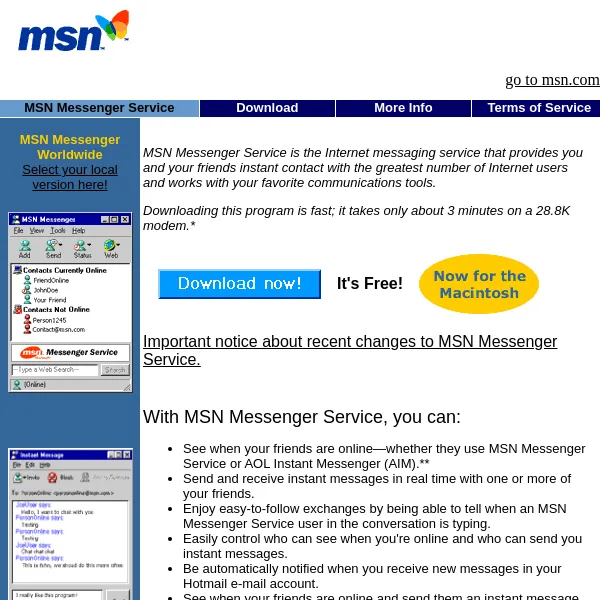
The download page promised it would take “only about 3 minutes on a 28.8K modem”. Version 1.0 was spartan: plain text, a contact list and not much else. But it had one feature that started a fight.
Why did AOL block MSN Messenger?
Microsoft was late to instant messaging. ICQ and AOL Instant Messenger (AIM) already had millions of users, and most of America’s online friendships lived on AOL’s servers. So the first version of MSN Messenger did something cheeky: it could sign in to AIM as well, letting you chat with AOL users without ever installing AOL’s software.
AOL wasn’t amused. Within a day, it changed its servers to spot Microsoft’s program and kick it off. Microsoft released a fix. AOL blocked it again. David Auerbach, one of the young Microsoft programmers on the team, later described coming in each morning to check whether Messenger still worked with AOL, then pulling apart the new block and shipping a fix the same day. The New York Times put the squabble on its front page.
Then AOL reached for a sneakier weapon. Auerbach found the server sending AIM a strange chunk of data that turned out to be machine code: AOL was exploiting a security hole in its own AIM software, one that let the server run code on your PC, to tell the real AIM apart from impostors. Someone at Microsoft then tipped off a security expert in an email signed by a “Phil Bucking” of “Bucking Consulting”, supposedly an independent developer. It had been sent from a Microsoft computer, and the email headers said so. Microsoft owned up, and the story became Microsoft’s fake email rather than AOL’s security hole.
Microsoft gave up the fight. The AOL feature quietly left MSN Messenger and never came back.
Messenger didn’t need it. Outside the US, AOL was never as dominant, and in Britain and much of Europe, MSN became the place where everyone was after school.
What made MSN Messenger so popular?
Partly it was Hotmail: if you had a Hotmail address, you already had a Messenger account. But mostly it was that Microsoft kept adding ways to show off. A quick tour, by version:
- Version 6 (2003) added display pictures, backgrounds and more emoticons, and the contact list began to look like a party.
- Version 7 (2005) added the nudge, the wink and the personal message. Microsoft said 155 million people were using Messenger every month, sending more than 2.5 billion messages a day.
- Version 8 (2006) brought a new name, Windows Live Messenger, and before long the ability to talk to friends on Yahoo! Messenger.
The display name
Before there was a status update, there was the display name. You could call yourself anything, and hardly anybody stopped at their actual name. Display names became lyrics, in-jokes, cryptic messages aimed at one person on your list, and a decorative frame of symbols around the lot. Changing it was a public act. Everybody on your list saw it, and everybody knew who it was about.
The nudge and the wink
The nudge was first tried out by a small group of beta testers in October 2004, reached the public beta of MSN Messenger 7.0 that December, and arrived for everyone in April 2005. One click, and your friend’s conversation window shook violently on their screen with a buzzing sound. It was meant for getting someone’s attention. It was used for being annoying. There was a limit on how often you could send one, and a whole generation learned exactly where it was.
Winks were the nudge’s louder cousin: big animations with sound that played across your friend’s chat window. Microsoft borrowed the idea from threedegrees, an earlier experimental messenger of its own. The Verge, writing Messenger’s obituary in 2014, called winks “super annoying”. Nobody who received one at 11pm on a school night would argue.
“What I’m listening to”
Version 7.0 also added the personal message: a line of text beside your name, where the lyrics could finally go so your display name didn’t have to carry them. It could also show the song playing in Windows Media Player or iTunes, live, as you listened. Microsoft’s own announcement suggested you might click your friend’s song to buy it from MSN Music. In practice, it meant everyone on your list knew you’d had the same song on repeat for three hours.
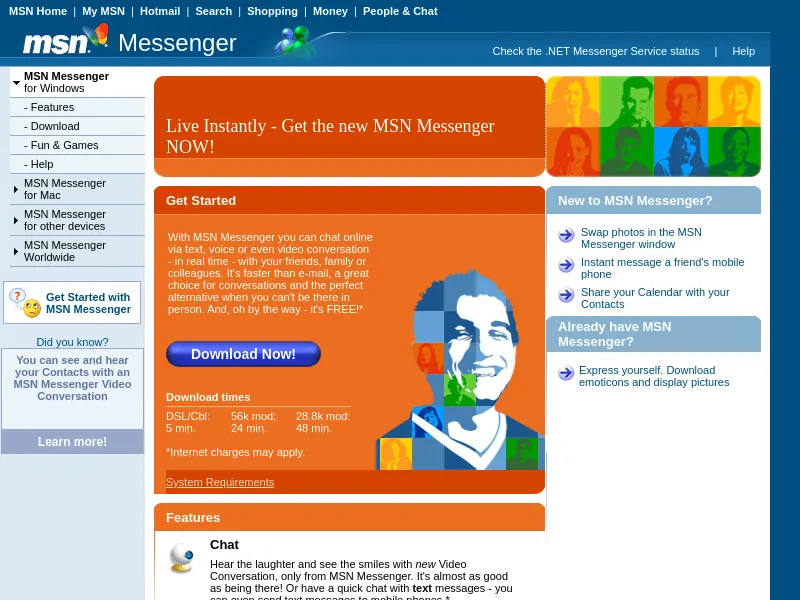
The 2005 home page above is a perfect period piece. Look at the download table: five minutes on broadband, 48 minutes on the dial-up modem that the 1999 page had promised would take three. Messenger had grown up, and it had grown fat.
Why did MSN Messenger become Windows Live Messenger?
In late 2005, Microsoft started moving its consumer services under a new brand, Windows Live. The first beta of Windows Live Messenger appeared on 13 December 2005, and version 8.0 was released on 19 June 2006. The software was officially Windows Live Messenger for the rest of its life. Almost nobody called it that. It was still “MSN”, as in “are you going on MSN later?”
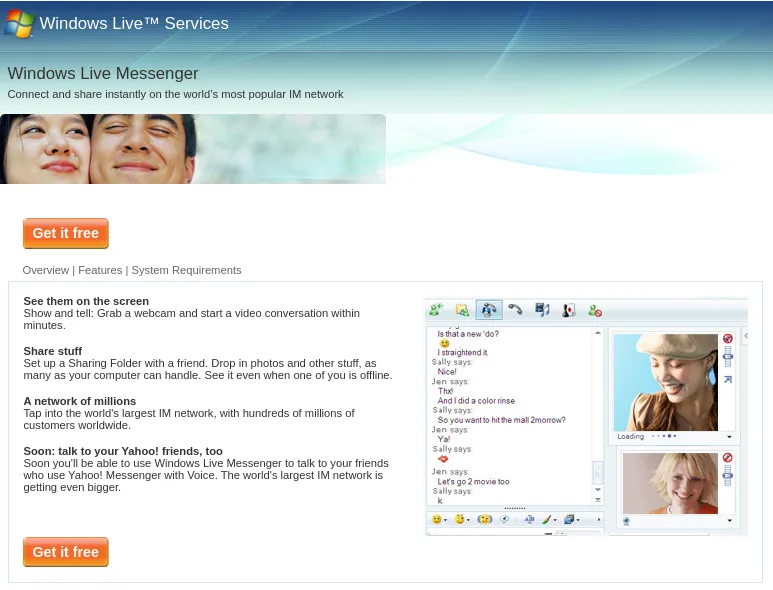
The new name came with a bigger ambition. Messenger began talking to Yahoo! Messenger users in July 2006, appeared on the Xbox 360 in 2007, and added Facebook chat in 2010. In June 2009, Microsoft said 330 million people a month were still using it, which made it one of the biggest messaging services in the world.
When did MSN Messenger shut down?
The end came in stages.
- May 2011: Microsoft agreed to buy Skype for $8.5 billion. Two chat services under one roof was one too many.
- 6 November 2012: Microsoft announced that Messenger would be retired in the first quarter of 2013, everywhere except mainland China, and that Messenger users should move to Skype. Your Messenger contacts would be waiting there.
- January 2013: emails went out naming 15 March 2013 as the date the service would stop working.
- 8 April 2013: the switch-off began, starting with English-speaking users. Each language group was moved in turn, with Brazilian Portuguese scheduled last, on 30 April. Signing in to Messenger now meant being sent to Skype.
- 31 October 2014: the last official Messenger service, in China, closed.
By the time the switch-off began, Messenger’s crowd had already thinned. When The Next Web reported the timetable in February 2013, Microsoft would only describe its Messenger users as numbering in the tens of millions, against 330 million less than four years earlier.
Why did Microsoft replace Messenger with Skype?
The short answer is that Microsoft had just paid $8.5 billion for Skype, and Skype was better at calls. The longer answer is that the place where friends talked had moved. In 2005, chatting meant a desktop computer, often the family one in the living room. By 2012, it meant a phone in your pocket, and Facebook, text messages and new apps had taken over the evening conversations that Messenger once owned.
Messenger also lost some charm along the way. Later versions dropped features that people liked, and each update seemed to add more advertising and less fun. By the time Microsoft folded it into Skype, it was less a beloved hangout than an old program most people had stopped opening.
What happened to Skype?
History repeated itself. On 28 February 2025, Microsoft announced that Skype would close on 5 May 2025, and invited its users to move to the free version of Microsoft Teams, or to export their chats and contacts and go. If you followed every step of the journey, your MSN contacts went from Messenger to Skype to Teams: three programs and one very long friends list.
Can you still use MSN Messenger today?
Not Microsoft’s version. For four years after the official switch-off, die-hards kept old copies talking to Microsoft’s servers with an unofficial patch called Messenger Reviver, until Microsoft shut its last Messenger server on 18 May 2017. Since then a group of fans have run a replacement service called Escargot, which lets old copies of MSN Messenger and Windows Live Messenger sign in and chat again. It’s a community-run project with no link to Microsoft, and it’s still running in 2026. In June 2026, Hackaday covered one collector who used it to bring back the i-Buddy, a USB figurine from the late 2000s that flapped its wings and lit up when a message arrived.
If you try it, treat it as what it is: old software from a less careful age, best run on a spare machine or in a virtual machine, never on the computer that holds your banking. The nudge still works. So, we’re told, does the sound of a friend signing in.
MSN Messenger timeline
- 21 July 1999: Microsoft announces MSN Messenger Service; downloads open at midnight on 22 July.
- July 1999: AOL blocks Messenger from its AIM network, and the code war begins.
- 17 July 2003: version 6.0 adds display pictures, backgrounds and more emoticons.
- October 2004: a limited beta of version 7.0 tests the nudge and the wink; the public beta follows in December.
- 7 April 2005: MSN Messenger 7.0 is released worldwide, with personal messages and “what I’m listening to”.
- 13 December 2005: the first beta of Windows Live Messenger.
- 19 June 2006: Windows Live Messenger 8.0 is released.
- July 2006: Messenger and Yahoo! Messenger users can talk to each other.
- June 2009: Microsoft reports 330 million monthly users.
- May 2011: Microsoft agrees to buy Skype.
- 6 November 2012: Microsoft announces that Messenger will be retired in favour of Skype.
- April 2013: starting on 8 April, Messenger users around the world are moved to Skype.
- 31 October 2014: Messenger closes in China, the last place Microsoft officially ran it.
- 18 May 2017: Microsoft’s last Messenger server shuts down, ending the unofficial Messenger Reviver patch.
- 5 May 2025: Skype closes, and its users are invited to move to Microsoft Teams.
Want more from the same years? Wander back through the Messenger Years, where the away messages, the Top 8 and the rest of the 2000s are waiting, along with what happened to Bebo, which a lot of us had open in the next tab.
Opens in a new tab
Sources
Each link opens a saved copy in the Internet Archive’s Wayback Machine, in a new tab, as the page was when we read it.
- Microsoft Launches MSN Messenger Service (Microsoft press release, 21 July 1999)
- Microsoft instant messenging app sparks code war (CNN, 23 July 1999)
- Chat Wars, by David Auerbach (n+1, issue 19, 2014)
- Global Availability of MSN Messenger and MSN Spaces Connects People Around the World (Microsoft press release, 7 April 2005)
- MSN Spaces debuts (The Register, 2 December 2004)
- MSN Messenger 7.0 limited beta test (TechSpot, October 2004)
- Windows Live Messenger has 330 million active users (Ars Technica, June 2009)
- Messenger's Skype transition will commence April 8th (The Next Web, 15 February 2013)
- MSN Messenger is shutting down after 15 years of memories (The Verge, 29 August 2014)
- Messenger Reviver 2 discontinued, by Jonathan Kay (MessengerGeek, 19 May 2017)
- The next chapter: moving from Skype to Microsoft Teams (Microsoft 365 Blog, 28 February 2025)
- Reviving MSN Messenger's i-Buddy USB accessory (Hackaday, 23 June 2026)
From the museum
