

What happened to MySpace?
 By Obscure Internet
 8 min read
MySpace never actually closed. It’s still there at myspace.com. What happened is that it lost everything else: its crown, its money and, eventually, its memories. Facebook caught it worldwide in April 2008 and in America in May 2009. News Corp, which had paid $580 million for it in 2005, sold it for about $35 million in 2011. Then, in 2019, the world found out that a server move had wiped out the music, photos and videos people had uploaded before 2015: an estimated 50 million songs.
If you were on it, you’ll remember the rest: a profile you’d spent a whole weekend decorating, a song that started playing the moment anyone visited, a friend called Tom you’d never met, and eight little squares that could start a feud. Here’s what happened to all of it.
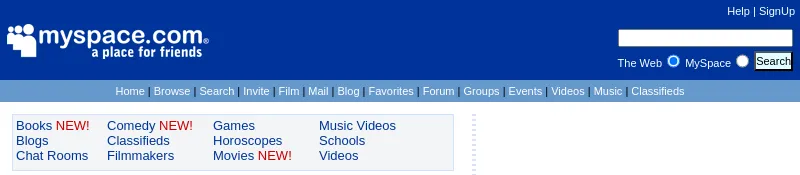
What was MySpace?
MySpace was a social network, and for a few years in the mid-2000s it was the biggest one in the world. It started in 2003 inside eUniverse, an internet company that later renamed itself Intermix Media. Tom Anderson, Chris DeWolfe and Josh Berman built it, with help from eUniverse’s boss, Brad Greenspan.
From the museum

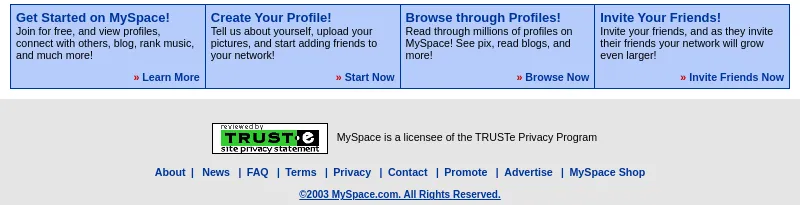
The idea wasn’t new. Friendster had got there first. But MySpace let you do far more with your page. You had a profile, a blog, a photo album, a list of friends and a wall of comments, and you could fill the lot with whatever you wanted the world to see. Bands could put their songs on it. By the end of 2004 it was inviting you to “blog, rank music, and much more”.
Who was Tom from MySpace?
Tom was everybody’s first friend. Sign up, and there he already was on your friends list: Tom Anderson, the co-founder, smiling over his shoulder in a white T-shirt. Millions of people who’d never met him kept him there for years.
He lost his title as president in 2009, when the rest of the founding team was shown the door, and stayed on with rather less to do. In February 2010 MySpace quietly stopped making him every new member’s first friend. These days he’s best known for his landscape photography, which, by every account, he’s thoroughly enjoying. There’s a whole card about Tom in this museum, because he deserves one.
Why could you change everything on your MySpace page?
By accident. According to Julia Angwin’s history of the company, Stealing MySpace, the site’s lead developer left a month after launch, and the two programmers brought in to rebuild it forgot to stop members adding their own HTML and CSS to their profiles. A panicking product manager reported that “someone hacked our site” after spotting a profile with new colours and a background picture. The company decided not to fix it, because, as one former staffer put it, “users come first, and this is what they want”.
So began the great MySpace makeover. People pasted in code from layout websites and tutorials, swapped the background for glitter or a band photo, changed every font, hid bits of the page, and added a song that played the moment anyone arrived. Pages took an age to load, and some were barely readable, but every one was unmistakably yours. For millions of people, it was the first code they ever wrote.
What was the MySpace Top 8?
The Top 8 was the little grid of eight friends on your profile, chosen and ranked by you, on public view. It caused more trouble than anything else on the site. The Los Angeles Times described it in 2006 as an exercise in naming “the eight most important people in your life” and ranking them in order, then showing the list to everybody you knew, “including people who didn’t make the cut”.
People fell out over it. People got back together over it. Some posted little notices above their Top 8 explaining how they’d chosen, to head off the arguments. It didn’t help. There’s a Top 8 card too, for anyone who still knows exactly who was in theirs.
Was MySpace really about music?
For a lot of people, yes. Bands could upload songs that played on their page, and fans could put a favourite on their own profile. For a while, MySpace was where you went to hear something new.
Lily Allen set up her MySpace page in late 2005, while her record label was still working out what to do with her. She posted demos and blogged, the songs spread, and by early 2007 she had more than 135,000 MySpace friends and a magazine had crowned her “the first lady of MySpace”. Her single “Smile” went to number one in Britain in 2006.
Arctic Monkeys are the other famous example, though they’d tell you it wasn’t them. The band handed out homemade demo CDs at gigs, and friends and fans put the songs online, where they spread through forums and MySpace. When their debut album came out in January 2006, it sold almost 120,000 copies in a single day and became the fastest-selling debut by a band in British chart history.
How big did MySpace get?
Big enough to be worth a fortune. In July 2005 Rupert Murdoch’s News Corp agreed to buy Intermix, MySpace’s parent company, for about $580 million. At the time, MySpace was already the fifth biggest website in terms of pages viewed, according to comScore.
A year later it was, by one count, the most visited of the lot. For the week ending 8 July 2006, the measurement firm Hitwise found that MySpace had more American visits than any other single website, edging out Yahoo Mail and Google. Yahoo pointed out, a little crossly, that it would have won if you’d counted all its sites together.
How did Facebook overtake MySpace?
Slowly, then all at once. Facebook started as a site for students, with plain blue pages that all looked the same. According to comScore, it drew level with MySpace worldwide in April 2008, with about 115 million visitors a month each. America held out longer: MySpace still had twice Facebook’s American audience that spring. But in May 2009 Facebook pulled ahead there too, by a whisker, with 70.29 million American visitors to MySpace’s 70.24 million.
It never looked back. In Britain and Ireland, a lot of us had been splitting our time with Bebo anyway, and chatting on MSN Messenger in another window. One by one, the friends, the bands and the comments moved to Facebook.
Who bought MySpace in 2011?
In June 2011 News Corp sold MySpace to an advertising company called Specific Media for about $35 million, mostly in Specific Media shares. That was a small fraction of the $580 million it had paid six years earlier. The pop star Justin Timberlake joined the deal, took a stake and promised to steer the site back towards music. About half of the site’s remaining 500 staff lost their jobs.
The new owners redesigned it, more than once. It didn’t bring the crowds back. In 2016 the magazine publisher Time Inc bought a majority stake in Viant, the company that by then owned MySpace, mostly for its advertising business.
What happened to the music on MySpace?
It was lost, and hardly anyone noticed at first. Members had complained for more than a year that old songs wouldn’t play. In 2018 MySpace started telling them the truth: “Due to a server migration, files were corrupted and unable to be transferred over to our updated site. There is no way to recover the lost data.” The news only spread in March 2019, when a post called “Myspace lost all music uploaded from 2003 to 2015” went viral. MySpace had once hosted an estimated 53 million songs from 14 million artists. For many small bands, their MySpace page had been the only place those recordings ever lived.
A tiny part of it came back. A few weeks later, the Internet Archive published what it called the MySpace Music Dragon Hoard: hundreds of thousands of songs from 2008 to 2010 (450,000, by the first count), gathered years earlier by an anonymous group of academics who’d downloaded 1.3 terabytes of MP3s to study music networks. It’s a small fraction of what was lost, but it came with its own search-and-play page, and people have found early tracks by artists who later became very famous indeed.
Can you still visit MySpace?
You can. Myspace.com is still online, and the copyright line at the bottom of the page still says 2014, which feels about right. Your old profile may still be there in some form, but the blogs, the songs, the photos and most of the glitter are gone.
If you’re looking for a band’s early recordings, search the Internet Archive for the “MySpace Dragon Hoard”. If you’re looking for your old page as it used to look, try the Wayback Machine, which kept copies of many public profiles. The two artefacts in this exhibit came from there.
MySpace: a timeline
- 2003: MySpace launches at eUniverse.
- October 2004: The home page invites you to blog, rank music and invite your friends.
- 18 July 2005: News Corp agrees to buy Intermix, MySpace’s parent company, for about $580 million.
- Late 2005: Lily Allen starts posting demos on her MySpace page.
- January 2006: Arctic Monkeys’ debut album becomes the fastest-selling debut by a band in British chart history.
- July 2006: Hitwise ranks MySpace the most visited single website in America for a week.
- April 2008: Facebook draws level with MySpace worldwide.
- May 2009: Facebook overtakes MySpace in America.
- February 2010: Tom stops being every new member’s first friend.
- June 2011: News Corp sells MySpace for about $35 million to Specific Media, with Justin Timberlake.
- February 2016: Time Inc buys a majority stake in Viant, MySpace’s owner.
- June 2013: A redesign drops years of members’ blogs and comments.
- 2018: MySpace tells members that music uploaded before 2015 can’t be recovered.
- March 2019: The loss of an estimated 50 million songs becomes news.
- April 2019: The Internet Archive publishes hundreds of thousands of rescued songs.
Why it still matters
MySpace taught a generation that a web page could be theirs: messy, loud, glittery and impossible to load on a school computer. It also taught us, the hard way, that a website you don’t own can lose everything you put on it. Keep your own copies.
There’s more from the same years in the Messenger Years, where the nudges, the away messages and the Facebook pokes are waiting.
Opens in a new tab
Sources
Each link opens a saved copy in the Internet Archive’s Wayback Machine, in a new tab, as the page was when we read it.
- News Corp. Acquires Intermix Media (InternetNews, 18 July 2005)
- MySpace 'Top 8' reveals true pals (Los Angeles Times, in The Honolulu Advertiser, 11 June 2006)
- MySpace Rules the Web (ClickZ, July 2006)
- From MySpace to her way, Lily Allen still 'Alright' (The Honolulu Advertiser, 4 March 2007)
- Facebook No Longer The Second Largest Social Network (TechCrunch, 12 June 2008)
- Facebook Surges Past MySpace in U.S. (InternetNews, 16 June 2009)
- MySpace sold to Specific Media and Justin Timberlake (TechRadar, 30 June 2011)
- Justin Timberlake Part of Group Buying MySpace (Associated Press, via Fox News, June 2011)
- Time Inc Acquires Viant, Owner Of Myspace And A Vast Ad Tech Network (TechCrunch, 11 February 2016)
- MySpace zaps millions of teens' tearful rants (The Register, 13 June 2013)
- Tom Has Finally Reached His MySpace Friend Limit (TechCrunch, 12 February 2010)
- Myspace apparently lost 12 years' worth of music, and almost no one noticed (Ars Technica, March 2019)
- Myspace has lost all music uploaded to the site between 2003 and 2015 (Mixmag, March 2019)
- The Internet Archive has uploaded 450,000 songs collected before Myspace's massive data loss (TechCrunch, 3 April 2019)
- MySpace and the coding legacy (Codecademy)
- Where are they now? How early Myspace founders shaped LA tech (Built In)
- Arctic Monkeys' classic debut album is 15 (The Star, Sheffield, 25 January 2021)
- Myspace (Wikipedia)
From the museum
