

What YouTube looked like in 2005
 By Obscure Internet

 10 min read
In 2005, YouTube was a plain, pale blue and white page with a red “Tube” logo, a search box and a list of the day’s featured videos, each with its own little row of red stars for ratings. You could upload any clip under 100 MB, there was no time limit, and you could paste any video straight into your MySpace profile or your blog.
It was also brand new. The domain was registered on Valentine’s Day 2005, the first video went up in April, and for its first few weeks the site was trying to be a dating service. By the end of the year it was serving more than 3 million videos a day. This is what it looked like before it was famous.
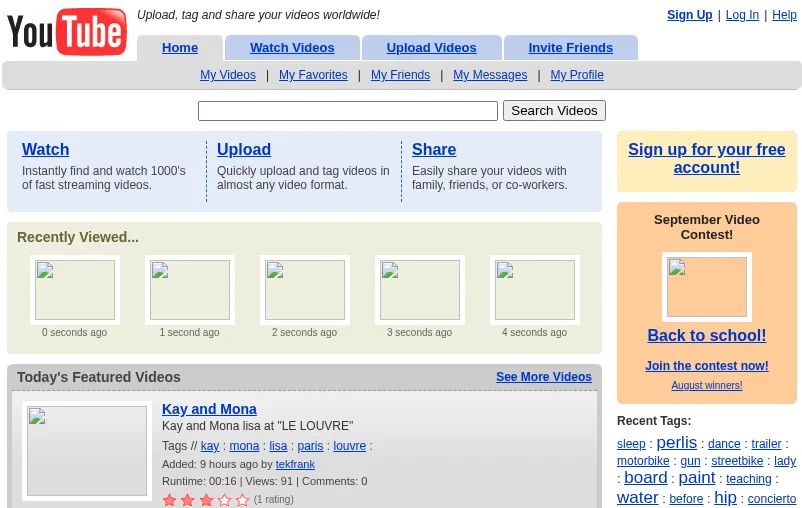
What did YouTube look like in 2005?
Like a friendly homemade web page, which is roughly what it was. The home page above was captured on 1 September 2005. At the top left sat the logo, with a cheerful line beside it: “Upload, tag and share your videos worldwide!” Below that were rounded pale blue tabs for Home, Watch Videos, Upload Videos and Invite Friends, and a single search box.
From the museum

Then came the pitch, in three columns. Watch: “Instantly find and watch 1000’s of fast streaming videos.” Upload: “Quickly upload and tag videos in almost any video format.” Share: “Easily share your videos with family, friends, or co-workers.”
Underneath was a strip called Recently Viewed, a live row of thumbnails labelled “0 seconds ago”, “1 second ago”, “2 seconds ago” and so on, showing what strangers had just been watching. Then Today’s Featured Videos: a 16-second clip called “Kay and Mona”, filmed at the Louvre, a home video from a swimming pool, someone’s Turkish coffee. Each came with its tags, its runtime, a view count in the dozens or hundreds, and a row of five red stars. Down the right-hand side was a box for the September Video Contest (“Back to school!”), a cloud of recent tags and a list of the last eight users online.
Nothing on it was slick, and that was deliberate. Chad Hurley, who’d been PayPal’s first user interface designer, designed the logo and the site, and the design writer Bill Moggridge, who interviewed him, said he’d avoided anything “overproduced, slick, or corporate-looking”, because he wanted the brand to be playful but trustworthy.
Did YouTube exist in 2005?
Yes: 2005 was its first year. The youtube.com address was registered on the evening of 14 February 2005, California time, which made it a Valentine’s Day present. The first video, “Me at the zoo”, went up on 23 April 2005. YouTube opened a public preview in May, and on 15 December 2005 it officially launched.
The company’s own fact sheet from 2006 says it was founded in February 2005 “from a garage in Menlo Park”. The money came in November 2005: $3.5 million from Sequoia Capital, the venture capital firm that had backed Google, Apple and Yahoo!.
Who started YouTube?
Three people who’d met at PayPal, the online payments company. Chad Hurley studied design and had been PayPal’s first user interface designer. Steve Chen was part of PayPal’s early engineering team. Jawed Karim had left the University of Illinois in 2000 to become one of PayPal’s first developers, and finished his computer science degree by correspondence in 2004.
The official origin story, as told in YouTube’s 2006 fact sheet, is a dinner party. A group of friends had been taking videos on their digital cameras, and when they tried to share the footage, they found it was far too hard to email or put on the web. Moggridge’s version adds that it was in San Francisco in January 2005, and that the emails kept bouncing because the files were so big.
Sequoia’s partner on the deal was Roelof Botha, who’d been PayPal’s chief financial officer. It was, in other words, a very PayPal sort of company.
Was YouTube a dating site?
At the very start, sort of. Karim told the story in his commencement speech at the University of Illinois in 2007: “We didn’t even know how to describe our new product. To generate interest, we just said it was a new kind of dating site,” he said. “We even had a slogan for it: Tune in, Hook up.”
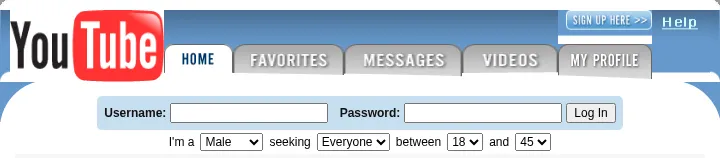
The Wayback Machine caught it. On 28 April 2005, five days after the first upload, the home page had a username and password box, and under it a row of drop-down menus: “I’m a Male seeking Everyone between 18 and 45.” The title bar already said “YouTube - Broadcast Yourself.”
Nobody came. Karim said he filled the empty site with videos of 747s taking off and landing, because videos of anything were better than no videos. According to Motherboard, the founders even put adverts on Craigslist in Las Vegas and Los Angeles, offering women $20 to upload a video. Nobody took them up on it.
“It didn’t even matter. Our users were one step ahead of us,” Karim said. “They began using YouTube to share videos of all kinds. Their dogs, vacations, anything.” By June the dating menus had gone. A capture from 14 June 2005 shows a home page with the slogan “Your Digital Video Repository”, a list of the latest tags and an “Upload Your Videos” button.
What was the first video on YouTube?
“Me at the zoo”, 19 seconds of Karim in front of the elephants at San Diego Zoo, uploaded on 23 April 2005. It’s got its own card in the museum, Me at the zoo, and it’s still up.
It wasn’t an instant hit. When the Wayback Machine captured its watch page in December 2006, “Added: April 23, 2005” by a user called jawed, it had 49,345 views, 165 comments and 411 ratings. Visitors were already leaving comments like “Is this really the first video on YouTube?”
What was the old YouTube logo?
The word “You” in dark letters, followed by “Tube” in white letters inside a red box with rounded corners. The box looked like an old television screen, which was the joke: “tube” was slang for a television, from the days when televisions ran on vacuum tubes.
It lasted 12 years. When YouTube finally replaced it on 29 August 2017, Christopher Bettig, head of YouTube’s art department, summed up the old one in an interview that day: “We have the word tube in a tube. This is weird.” He also revealed its typeface, Alternate Gothic No. 2, which dates from 1903, and that it had been tweaked by hand, so the U in “Tube” didn’t quite match the U in “You”.
The new logo kept the wordmark but moved the emphasis onto the red play button beside it, which by then had become YouTube’s unofficial symbol anyway. So if you remember a red box with “Tube” in it, you’re remembering the logo from 2005 to 2017. You’ll find it on every capture in this exhibit.
What could you do on YouTube in 2005?
Watch, upload, rate, tag, comment and save favourites, all free. The help page put it plainly: “Is this service really free? Yes, completely free. No strings attached.”
The rules were generous. In July 2005 the help page said “There is no time limit on your video, but the video file you upload must be less than 100 MB in size.” You could upload .AVI, .MOV or .MPG files from most digital cameras and mobile phones. It suggested you tidy them up first in Windows Movie Maker or Apple iMovie, and by December it was explaining what to do if you’d accidentally uploaded a Movie Maker project file instead of the film. You couldn’t download videos, but you could save them to your favourites.
The clever part happened behind the scenes. Before YouTube, as its launch announcement said, the burden was on you to cope with multiple media players and hundreds of formats. YouTube converted every upload into Flash video, which played in Internet Explorer and Firefox alike, and YouTube said 97 per cent of internet users already had Flash. If a video wouldn’t play, the help page had one answer: install the latest Macromedia Flash. (Years later, Flash’s death left a grey jigsaw piece where much of this era used to be, which is why the old video players won’t run in the archived pages. The blank thumbnails are a different gap: most of the little images simply weren’t archived.)
The famous 10-minute limit came later. YouTube brought it in during March 2006, to keep out unauthorised uploads, and set up a Director scheme the next month for people who made longer videos of their own.
How did YouTube get so popular?
By letting its videos leave home. Every video page came with a snippet of code, an “embeddable source” as the help page called it, that you could paste into another website. The video would then play right there, on your blog or your profile.
That mattered because 2005 was the year of MySpace, where millions of people had a profile page they could fill with whatever HTML they liked. By December, YouTube’s help page had a question that ended in a “?!?”: “How do I embed videos on my MySpace/Friendster profile?!?”
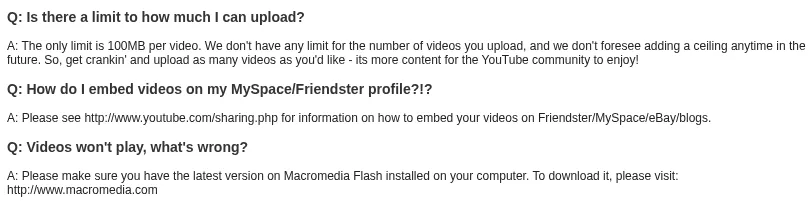
YouTube’s launch announcement made the same point in grown-up language: users could “insert their favorite YouTube videos into their MySpace profiles, blogs or personal Web pages”. Every embedded video was a small advert for YouTube, sitting on someone else’s page. When the company described itself in 2006, video embedding “into MySpace accounts, blogs, or other Web sites” was the first feature on the list.
How many videos were uploaded to YouTube in 2005?
We haven’t found an official total for the year, but YouTube did publish daily figures, and they climbed fast. In November 2005, Hurley said the site was moving 8 terabytes of data a day, “the equivalent of moving one Blockbuster store a day over the Internet”. At the official launch on 15 December, it said a typical day meant more than 3 million videos served, 8,000 new uploads and 16 terabytes of data. “We’re moving the equivalent of two Blockbuster stores every day,” said Hurley, “and that’s only a start.”
He wasn’t wrong. By June 2006 YouTube was serving 50 million videos a day, with more than 50,000 uploads a day. By October 2006, it was 100 million views and 65,000 uploads a day.
When did Google buy YouTube?
On 9 October 2006, less than 20 months after the domain was registered, Google announced that it would buy YouTube for $1.65 billion in shares. In April 2006 YouTube had raised a second round of $8 million, again with Sequoia; now the whole company was going to Google. The deal closed on 13 November 2006.
Google promised that YouTube would “operate independently to preserve its successful brand and passionate community”, stay in San Bruno, California, and keep all its staff. Hurley called what YouTube’s users had built “a new clip culture”. If you’ve read our exhibit on BackRub, there’s something pleasing about the company that started out as BackRub buying the one that started out as a dating site.
YouTube in 2005: a timeline
- 14 February 2005: youtube.com is registered, on Valentine’s Day evening in California.
- 23 April 2005: Jawed Karim uploads “Me at the zoo”.
- 28 April 2005: The home page asks who you’re seeking, and between what ages.
- May 2005: YouTube opens a public preview.
- June 2005: The dating menus are gone; the home page calls YouTube “Your Digital Video Repository”.
- July 2005: The help page sets a 100 MB limit per video, and no time limit.
- September 2005: The home page shows Recently Viewed, star ratings and a back-to-school video contest.
- 7 November 2005: Sequoia Capital invests $3.5 million.
- 15 December 2005: YouTube officially launches, serving more than 3 million videos a day.
- March 2006: The 10-minute limit arrives.
- 9 October 2006: Google agrees to buy YouTube for $1.65 billion in shares.
- 13 November 2006: The deal closes.
- 29 August 2017: The red Tube box is retired for a play button.
Before they were famous
It’s strange to look at 2005’s YouTube now: “1000’s” of videos, a list of the last eight users online, a dating menu nobody used and a featured video of someone’s Turkish coffee. But all the pieces were already there, from the stars and the tags to the little box of code that let a video wander off to MySpace and bring people back. There’s more from the same years in The Messenger Years, including TheFacebook as it was a year earlier, and more giants in their earliest form in Before They Were Famous.
Opens in a new tab
Sources
Each link opens a saved copy in the Internet Archive’s Wayback Machine, in a new tab, as the page was when we read it.
- YouTube home page (youtube.com, 28 April 2005)
- YouTube home page (youtube.com, 14 June 2005)
- YouTube home page (youtube.com, 1 September 2005)
- YouTube Help (youtube.com, July 2005)
- YouTube Help (youtube.com, December 2005)
- YouTube Receives $3.5M in Funding From Sequoia Capital (YouTube press release, 7 November 2005)
- YouTube Opens Internet Video to the Masses (YouTube press release, 15 December 2005)
- YouTube Fact Sheet (youtube.com, June 2006)
- Me at the zoo, watch page (youtube.com, December 2006)
- Google Closes Acquisition of YouTube (Google press release, 13 November 2006, filed with the SEC)
- Google To Acquire YouTube for $1.65 Billion in Stock (Google press release, 9 October 2006, filed with the SEC)
- 10 Years Ago Today, YouTube Launched as a Dating Website (Motherboard, April 2015)
- YouTube co-founder to be commencement speaker at Illinois (University of Illinois News Bureau, 2007)
- Designing Media: Chad Hurley, by Bill Moggridge (Cooper Hewitt, March 2011)
- YouTube gets a new logo (CNBC, 29 August 2017)
- YOUTUBE.COM registration record (Verisign RDAP)
Do you remember?

From the museum
