

What happened to Ask Jeeves?
 By Obscure Internet

 8 min read
Ask Jeeves closed for good on 1 May 2026. By then it had been plain Ask.com for twenty years: the internet company IAC bought it in 2005, retired its famous butler the following February, and finally switched off the whole search business almost three decades after the first question was typed in. Where the search box used to be, there’s now a farewell page. Its last line reads “Jeeves’ spirit endures.”
If you were online at the turn of the millennium, you probably asked him something. Maybe it was homework. Maybe it was “why is the sky blue?” Maybe it was a question you’d rather not have typed on the family computer. Either way, you asked it in plain English, and a cartoon butler went off to find the answer. Here’s what happened to him.
What was Ask Jeeves?
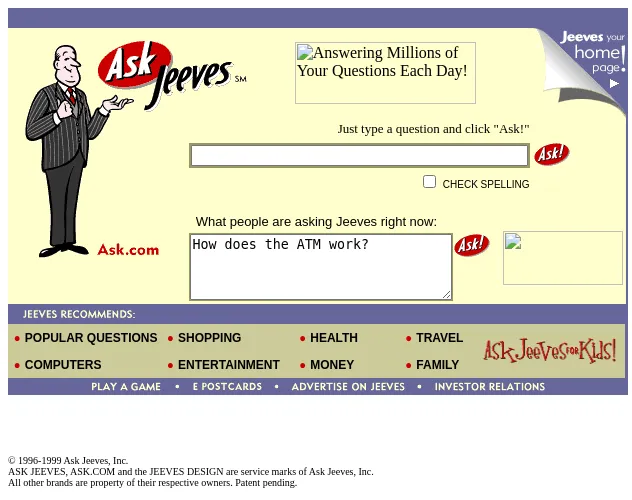
Ask Jeeves was a search engine you could talk to. Most search engines of the 1990s wanted keywords, so you learned to type like a telegram: “cheap flights Paris”. Ask Jeeves invited you to type a proper question, such as “How does the ATM work?”, and it would try to understand it and point you to an answer.
From the museum

It was the idea of Garrett Gruener, a venture capitalist, and David Warthen, a technologist, in California. They didn’t want to build another search engine or directory. They wanted a question-answering service, which Search Engine Watch later summed up as “a virtual online concierge”. The site opened to the public in the spring of 1997.
The concierge needed a face, and they borrowed a famous one. Jeeves is the unflappable valet in P.G. Wodehouse’s stories, the man who always knows the answer while Bertie Wooster flaps about. An artist named Marcos Sorensen drew the version everyone remembers: the tall butler in a pinstriped suit, a hand held out as if to say “allow me”.
How did Ask Jeeves find its answers?
Mostly with people. Behind the butler sat a team of editors, working in groups by subject. Business, health and law had specialists; everything else went to generalists who were good at finding things online. They wrote question-and-answer templates and chose which websites answered each one.
By 2000, ONLINE magazine reported, the result was a knowledge base of about 7 million questions, built from several thousand of those templates. When you typed a question, Jeeves showed you the closest matches it knew, sometimes with drop-down boxes to narrow down what you’d meant. If you clicked one, you got the page an editor had picked.
And if Jeeves didn’t know, he asked around. The site also searched AltaVista, Excite, Infoseek, WebCrawler and Yahoo! and showed you what they found. The editors watched which answers people found useful, swapped in better websites when they found them, and wrote new templates when something was in the news. It was less a thinking machine than a very well-organised library with a butler at the front desk.
Why was Ask Jeeves so popular?
Partly it was the butler. Search engines were cold, technical things, and Jeeves was a character. He felt polite, slightly old-fashioned and very British, which on a 56k modem in 1999 was oddly reassuring.
And partly it was the timing. Ask Jeeves arrived just as millions of people were going online for the first time, and many of them didn’t know what a keyword was. Asking a question felt natural. The 1999 home page even showed a live sample of what other people were asking, which was its own kind of entertainment.
Then came the money. Ask Jeeves floated on the Nasdaq on 1 July 1999, under the ticker ASKJ. The shares had been pitched at $10 and were priced at $14. They closed their first day at $64.94, a rise of 364 percent, having touched $77.81 along the way. It was the dot-com boom at full volume, the same boom in which Yahoo paid billions for GeoCities.
Was Jeeves really on fruit?
Yes, and that’s not a sentence anyone expected to write. Ask Jeeves spent its new money on some memorable marketing. In the autumn of 1999 it put questions on stickers on 15 million apples. In March 2000 it moved on to 60 million oranges. In April 2000 it signed a deal with Dole to label 100 million bananas, with the butler’s face and questions such as “What nutrients are in bananas?”
Jeeves also became a giant balloon in the Macy’s Thanksgiving Day Parade in New York. Search Engine Watch called him the first internet “character” to float in it.
There was one small oversight. Nobody had asked the Wodehouse estate whether they could use Jeeves. A.P. Watt, the literary agents who looked after it, threatened legal action, and the two sides settled in early 2000 without saying how. For a company built on asking, it was quite something to have forgotten to.
What went wrong for Ask Jeeves?
Google. It launched in 1998 and was simply better at finding things, whether you typed a question or not. As people got used to searching, they stopped needing a butler to translate for them, and Ask Jeeves spent the 2000s trying to keep up.
The butler kept changing to fit. In 2004 Jeeves “went missing” and, it turned out, had been on a world tour, coming home noticeably trimmer and slimmer. On 1 April 2005 the company unveiled the “Jeeves 9000”, a robot version of him, which was as much of an April Fools’ joke as it sounds.
Why did IAC buy Ask Jeeves?
On 21 March 2005, IAC/InterActiveCorp, the company run by the media mogul Barry Diller, agreed to buy Ask Jeeves in a share deal worth $1.85 billion. Ask Jeeves’s shareholders got 1.2668 IAC shares for every Ask Jeeves share they held, a premium of about 16 percent. IAC wanted a search engine of its own to put alongside its other websites.
It didn’t want the butler. Search Engine Watch reported that Jeeves “was left out of the negotiations”, and that in September 2005 Diller told TheStreet.com the butler was going to be sacked.
When did Jeeves retire?
In February 2006. After nearly a decade of service, Jeeves stepped down and Ask Jeeves became simply Ask, at Ask.com. He got a send-off fit for a long-serving member of staff: a retirement website, where visitors could vote on his next career and send him their best wishes.
Without him, Ask tried to compete with Google on Google’s own terms, and it didn’t work. In November 2010 it gave up. Ask laid off 130 search engineers in New Jersey and China, handed its search results to an outside company it didn’t name, and turned to answering questions with a Q&A service instead. At the time Google handled about two-thirds of American searches, and Ask fewer than 4 percent. A couple of months earlier, Diller had told the TechCrunch Disrupt conference that Ask wasn’t competitive with Google at all, and quipped that “Ask has no value inside of IAC”. He later explained that he’d meant the stock market wasn’t valuing it, not that it was worthless.
Did Jeeves ever come back?
In Britain, he did. In April 2009 the UK site took back the name Ask Jeeves and brought him out of retirement, redrawn as a smart 3D character by Framestore, the visual effects company behind The Golden Compass and the Narnia films. Ask said a YouGov poll had found 83 percent of people in Britain recognised the Ask Jeeves brand.
Jeeves, naturally, had a statement ready. “During my sojourn research showed the public wanted me back,” he said on his “why am I back” page, “which I found jolly touching.”
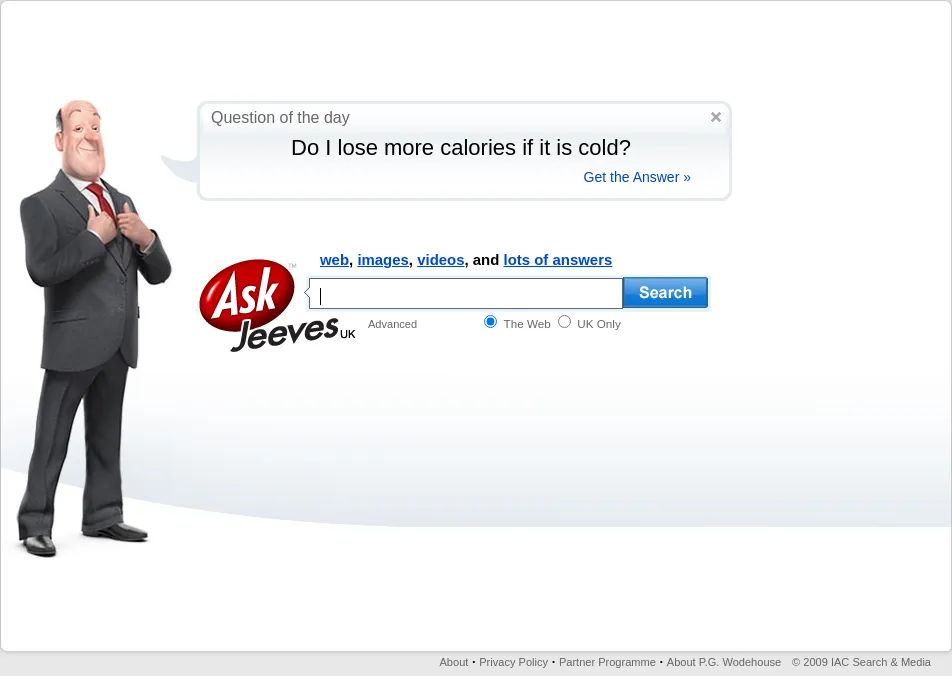
Ask said it had no plans to bring him back in America, which is perhaps the most British thing about the whole story. The page above still has a link in its footer to “About P.G. Wodehouse”.
When did Ask.com close?
On 1 May 2026. IAC announced that it was discontinuing its search business, Ask.com included, as part of sharpening its focus. The site’s search box was replaced by a single page, headed “Every great search must come to an end.”
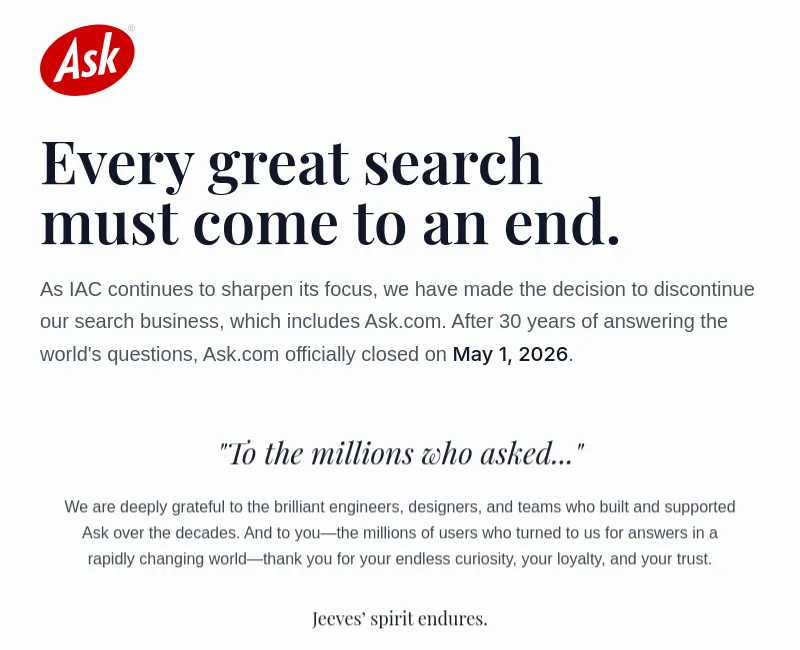
The page thanks “the millions who asked”, and it signs off with a nod to the butler who’d been gone for twenty years: “Jeeves’ spirit endures.” It’s hard to think of another company that gave its retired mascot the last word.
Was Ask Jeeves the first chatbot?
Not quite, but it’s a fair comparison. When TechCrunch reported the closure, it called Ask Jeeves “arguably a precursor to today’s AI-powered chatbots”. The pitch was the same: ask in plain English, and a polite helper will find the answer. The difference is underneath. Jeeves’s answers were chosen by people, and when he didn’t know, he sent you somewhere else; today’s chatbots write their answers themselves. Jeeves was simply thirty years early, and a great deal better dressed.
Ask Jeeves: a timeline
- 1996: Garrett Gruener and David Warthen start Ask Jeeves in California.
- Spring 1997: Ask Jeeves opens to the public.
- 1 July 1999: Shares are priced at $14 and close their first day at $64.94.
- Autumn 1999 to spring 2000: Questions on 15 million apples and 60 million oranges, then a deal for 100 million bananas.
- Early 2000: A settlement with the Wodehouse estate over the use of Jeeves.
- 2004: Jeeves goes on a “world tour” and comes back slimmer.
- 21 March 2005: IAC agrees to buy Ask Jeeves for $1.85 billion.
- February 2006: Jeeves retires, and Ask Jeeves becomes Ask.com.
- April 2009: Jeeves returns to the British site in 3D.
- November 2010: Ask gives up building its own search engine.
- 1 May 2026: Ask.com closes.
More from the years when you could still ask a butler anything waits in The Dial-up Years.
Opens in a new tab
Sources
Each link opens a saved copy in the Internet Archive’s Wayback Machine, in a new tab, as the page was when we read it.
- By Jove, Ask Jeeves Rockets On IPO (InternetNews, July 1999)
- Reference Resources on the Web, by Chris Sherman (ONLINE magazine, 2000)
- Fireworks Come Early For Internet IPOs (InternetNews, July 1999)
- Ask Jeeves Gets Fruity With Marketing Efforts (InternetNews, 13 April 2000)
- IAC to buy Ask Jeeves (CNN Money, 21 March 2005)
- Jeeves Retires (Search Engine Watch, 20 February 2006)
- The Return of Jeeves (in the UK) (Chief Marketer, April 2009)
- The Return of Jeeves (Technologizer, 19 April 2009)
- Barry Diller: Ask.com Has No Value Inside Of IAC (TechCrunch, 29 September 2010)
- Ask.com Gives Up On Search, Hangs Its Hopes On Q&A (TechCrunch, 9 November 2010)
- Farewell, Jeeves: Ask.com shuts down (TechCrunch, 2 May 2026)
- Ask.com shuts down after over 25 years (Search Engine Land, May 2026)
- Ask.com closing notice (IAC, 2026)
- Ask.com (Wikipedia)
From the museum
