

What happened to Miniclip?
 By Obscure Internet

 10 min read
Miniclip is still going, but the website you remember isn’t. In the summer of 2022 Miniclip.com dropped almost every browser game it had, kept just 8 Ball Pool and Agar.io, and turned into a shop window for one of the biggest mobile games companies in the world, now owned by China’s Tencent.
So the company won. The site that filled a thousand school computer rooms is the bit that didn’t make it. Here’s how a game about a dancing president turned into a billion-download business, and where the games you actually remember went.
What was Miniclip?
Miniclip was a free games website, and for a few years in the 2000s it was more or less the default answer to “what shall we do now?” for anyone with a browser and a spare twenty minutes. Everything ran in the browser, mostly in Flash and later Shockwave, so there was no game to install, just the plug-in most computers already had.
From the museum

Robert Small described the scale in an interview with Gamasutra in August 2007. Miniclip had more than 36 million unique users a month, more than 260 games, and most of them were only playable on Miniclip. Its core audience was “tweens”, and he said they were “hugely chatty”, spreading the word on blogs, on instant messenger and “in schools and colleges”. That explains a great deal about the ICT room.
He also said “we have a lot of teachers visiting the site”, which is the most optimistic way anyone has ever described the back row of a computer lesson.
Who started Miniclip?
Miniclip was founded in 2001 by Robert Small and Tihan Presbie. Small was, in his own words, “fresh out of university”, an avid gamer since his parents bought him a ZX Spectrum. Presbie had come from trading on the futures market. They met through friends, wanted to start an online business, and taught themselves Flash.
The first title on the site was Dancing Bush, which the pair programmed in their flat, according to Miniclip’s own history. It was exactly what it sounds like: a cartoon George W. Bush dancing to the theme from Saturday Night Fever. Small said they sent it to about 4,000 people, and within a couple of months about 2 million people had played it.
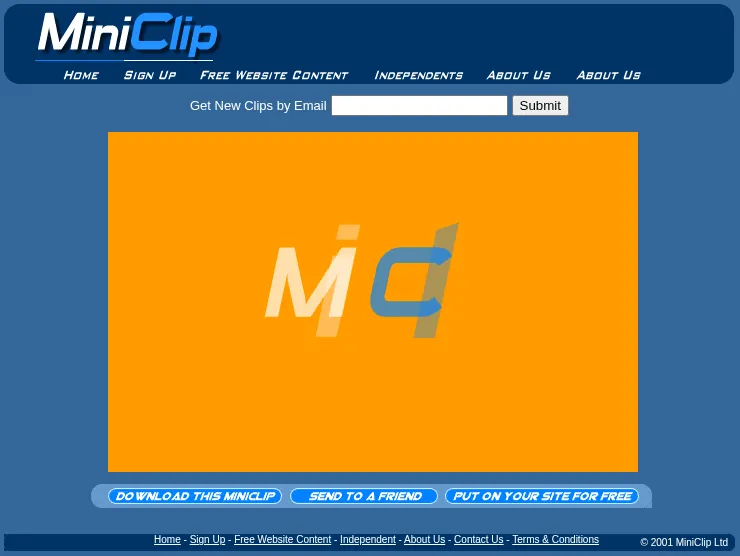
That was the trick. The early site wasn’t really a games site at all. It was a place for “clips”, tiny Flash files built to travel. Each clip’s page had buttons to download it, send it to a friend, or put it on your own website for free, and a journalist quoted on Miniclip’s own press page reported that one emailed Bush clip brought the site 10 million hits. Flash files were tiny next to video, which mattered when most people were still on dial-up.
More politicians followed: Bush Shoot-Out, Bush Aerobics, Dancing Blair, Cherie “Disco” Blair and Dancing Hillary were all still on the menu in 2005. Small later admitted the political jokes brought spikes, not loyalty. To keep people coming back, Miniclip needed proper games.
How did Miniclip get so big?
It made its own games, and it paid other people to make them too. Small said in 2007 that Miniclip built about 30% of its games itself and worked with a network of about 100 developers all over the world, usually paying developers up front for a licence instead of sharing ad money. “We can make a decision within ten minutes,” he said, “and have the game developed and out within a week.”
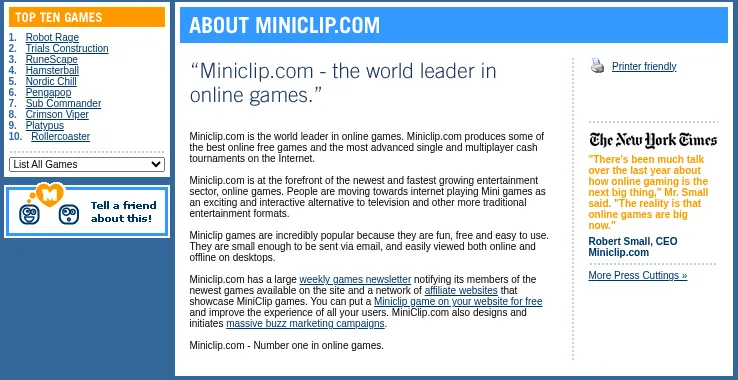
By January 2005 the About page was calling Miniclip.com “the world leader in online games”, and Miniclip’s later history says it became the number one online games website that year. In those years it didn’t pay for advertising. The players did the marketing.
The money came from adverts and, increasingly, from games that were adverts. Coca-Cola, Disney, Gillette and Warner Bros all paid for games on the site, and Small said Miniclip guaranteed sponsors ten million plays. The star example was Extreme Pamplona, a five-level game for Sure for Men. Small said it did 25 million plays in a month, which is a great deal of attention for a deodorant.
What were the classic Miniclip games?
Everyone has their own list, and that’s half the fun, but a few names come up again and again. Here’s the catch: plenty of the most famous “Miniclip games” weren’t made by Miniclip. The site licensed games from other studios and put them in front of millions of players.
- Motherload was made by XGen Studios in 2004. You flew a little mining pod on Mars, dug for ore, sold it, and upgraded until the fuel ran out at exactly the wrong moment. It sat on Miniclip for years.
- 8 Ball Pool was Miniclip’s own. It started on the website in 2010 and became the biggest game on the site, with 20 million visits a month.
- Bloons was made by Ninja Kiwi, not Miniclip. Its games, Bloons TD 5 among them, turned up on Miniclip too.
- Club Penguin wasn’t Miniclip’s either, but it topped the site’s Top Ten in the summer of 2006. You can read what happened to Club Penguin in its own exhibit.
Then there are the hundreds of others that only one group of friends seems to remember: Sushi Go Round, Bubble Trouble, Raft Wars, Papa Louie, Hamsterball and Trials. The 2007 game menu alone ran to more than 300 titles.
What happened to Miniclip?
It followed its players onto their phones. Miniclip says its mobile focus began in 2010, and 8 Ball Pool arrived on phones at the start of 2013. At first Miniclip charged for it, then made it free in October 2013, and that’s when it really took off. By 2021 it had passed a billion downloads, and Guinness World Records named it the most downloaded mobile pool game.
The browser site, meanwhile, was running out of road. Flash was dying across the whole web: Adobe stopped supporting it at the end of 2020 and blocked Flash content from January 2021 (the full story is in what happened to Flash games). Younger players were on phones and tablets anyway.
On 7 April 2022, Miniclip announced the end of the old site. Miniclip.com would carry on “in its current format until summer 2022”, and then become a place for “potential partners, prospective candidates” and business news. Only 8 Ball Pool and Agar.io would stay playable in a browser. By then the company was talking about 250 million mobile players a month, and the website that built it was being kept, in its own words, as part of its “legacy”.
Plenty of people only noticed in October 2022, when the news went round on Twitter. PC Gamer’s headline said what everyone was feeling: “Miniclip, home of childhood nostalgia, is finally dead”. It called the site “the IT lesson disrupter”. Miniclip replied that it “hasn’t gone anywhere”, said it was humbled by the memories people were sharing of “the beloved games we sunset earlier this year”, and pointed out that 75 million people were playing its games every day.
Both were right. The company was fine. The website wasn’t.

What happened to the old Miniclip games?
Most of them went with Flash. Once browsers stopped running Flash, a game that nobody rebuilt or preserved stopped working, and Miniclip had no reason to rebuild hundreds of small games from the 2000s when its business was on phones. The sponsored games and most of the lunchtime time-wasters have no official home now.
The games that came from other studios are a different story, because they never belonged to Miniclip in the first place. Several of their makers have kept them alive themselves, which brings us to the useful bit.
Where can you play old Miniclip games now?
Here’s where the famous ones can be played legitimately today, from the people who made them.
- 8 Ball Pool: still on Miniclip’s website, and as an app for iPhone, iPad and Android. It’s the only classic that never left.
- Agar.io: also still on Miniclip’s website. It came along much later, so it’s more “end of an era” than “school computer room”, but it’s there.
- Motherload: XGen Studios made a sequel, Super Motherload, which came out in November 2013 and is on Steam for Windows and on PlayStation 3 and 4. The Steam version comes with Motherload Goldium Edition, XGen’s own edition of the 2004 original, at no extra cost.
- Bloons: Ninja Kiwi put its old Flash games, including the early Bloons games and the Flash version of Bloons TD 5, into the Ninja Kiwi Archive, a free download on Steam since 8 July 2020. It has more than 60 of the studio’s Flash games, kept as they were.
- Club Penguin: Disney closed it in 2017, and there’s no official version to play.
- Dancing Bush: Miniclip uploaded it to Newgrounds itself in July 2001, under its own name, and the page is still there.
For everything else, the best hope is preservation. Flashpoint Archive is a volunteer project that has saved a huge number of web games so they can be played offline, and it’s the first place to look if a game you loved has vanished. We only point to places where the people who made a game put it themselves, so we don’t link to copies on other game sites.
Who owns Miniclip now?
Miniclip is owned by Tencent, the Chinese technology giant that Miniclip itself called the world’s largest games publisher. Tencent bought a majority stake in February 2015 and didn’t say what it paid. “To say that we are excited about having Tencent as a majority investor in Miniclip would be an understatement,” said Robert Small, who was still chief executive. At that point Miniclip was based in Switzerland and had 70 million players a month. By the time Miniclip bought Easybrain in 2024, the trade press was simply calling it Tencent-owned.
Small is no longer in charge day to day. Saad Choudri, who joined in 2011, became chief executive in November 2021, and Small stayed on as president and co-founder.
Since then Miniclip has been buying other studios. In 2022 it agreed to buy SYBO, the Danish maker of Subway Surfers. It also bought FuturLab, the studio behind PowerWash Simulator, and in November 2024 it agreed to buy Easybrain, the company behind Sudoku.com, for $1.2 billion. Its website now says it reaches more than 400 million players a month and has passed 10 billion downloads.
So the people who once emailed a dancing president to 4,000 people now run a company that owns Subway Surfers. Not a bad return on a Flash clip made in a flat.
Is Miniclip still active?
Yes, very much, as a mobile games company, and its website is still at the same address. What’s gone is the giant menu of free games, and the feeling that one website held everything you might want to play before the bell went.
Miniclip: a timeline
- 2001: Robert Small and Tihan Presbie launch Miniclip in London. Its first title is Dancing Bush.
- January 2005: The site calls itself “the world leader in online games”.
- 2006: Club Penguin tops Miniclip’s Top Ten.
- August 2007: Small says Miniclip has 36 million users a month and more than 260 games.
- 2010: 8 Ball Pool launches on the website, and Miniclip turns its focus to mobile.
- Early 2013: 8 Ball Pool arrives on phones.
- February 2015: Tencent takes a majority stake.
- November 2021: Saad Choudri becomes chief executive.
- 7 April 2022: Miniclip announces that the website will drop all but two of its games that summer.
- June 2022: Miniclip agrees to buy SYBO, the maker of Subway Surfers.
- October 2022: The news spreads, and PC Gamer declares Miniclip “finally dead”.
- November 2024: Miniclip agrees to buy Easybrain for $1.2 billion.
More from the same years waits in The Playground Years.
Opens in a new tab
Sources
Each link opens a saved copy in the Internet Archive’s Wayback Machine, in a new tab, as the page was when we read it.
- Miniclip announces evolution of web gaming platform after 21 years as it deepens focus on mobile (Miniclip press release, 7 April 2022)
- Q&A: Small On MiniClip's Social & Advergaming Approach (Gamasutra, 29 August 2007)
- Press cuttings (Miniclip.com, December 2003 capture)
- About Miniclip.com (Miniclip.com, January 2005 capture)
- Extreme Pamplona (Miniclip.com, June 2007 capture)
- Miniclip home page (July 2006 capture)
- Bloons TD 5 on Miniclip (Brazilian edition, December 2012 capture)
- Tencent makes majority investment in Miniclip (PocketGamer.biz, 19 February 2015)
- From flash game to world's most downloaded pool title: Miniclip's Sérgio Varanda on lasting success of 8 Ball Pool (Game World Observer, 23 December 2021)
- Saad Choudri appointed as Miniclip CEO (PocketGamer.biz, 11 November 2021)
- Miniclip to acquire Subway Surfers studio Sybo (PocketGamer.biz, June 2022)
- Miniclip, home of childhood nostalgia, is finally dead (PC Gamer, 25 October 2022)
- Miniclip acquires Easybrain from Embracer for $1.2bn (Mobilegamer.biz, 14 November 2024)
- Miniclip home page (October 2026 capture)
- Our story (Miniclip, October 2026 capture)
- Web Games (Miniclip, October 2026 capture)
- Super Motherload (XGen Studios, Steam store page)
- Ninja Kiwi Archive (Ninja Kiwi, Steam store page)
- Dancing Bush by MiniClip (Newgrounds, uploaded 24 July 2001)
- Flashpoint Archive
Do you remember?

From the museum
