

What happened to Moshi Monsters?
 By Obscure Internet

 11 min read
Moshi Monsters closed at midday on 13 December 2019, when Mind Candy switched off the original game because it ran on Flash, which Adobe was about to kill. The original’s gone for good, but the monsters are back in two ways: Moshi Online, a fan-built restoration, became an official part of Mind Candy in 2025, and Mind Candy is making a brand-new game, crowdfunded on Kickstarter, for a global launch in 2027.
That’s the short answer. The longer one involves a London company on the brink of bankruptcy, a monster sketched in a café, a magazine that outsold every other children’s title in Britain, and a pop star’s lawyers.
What was Moshi Monsters?
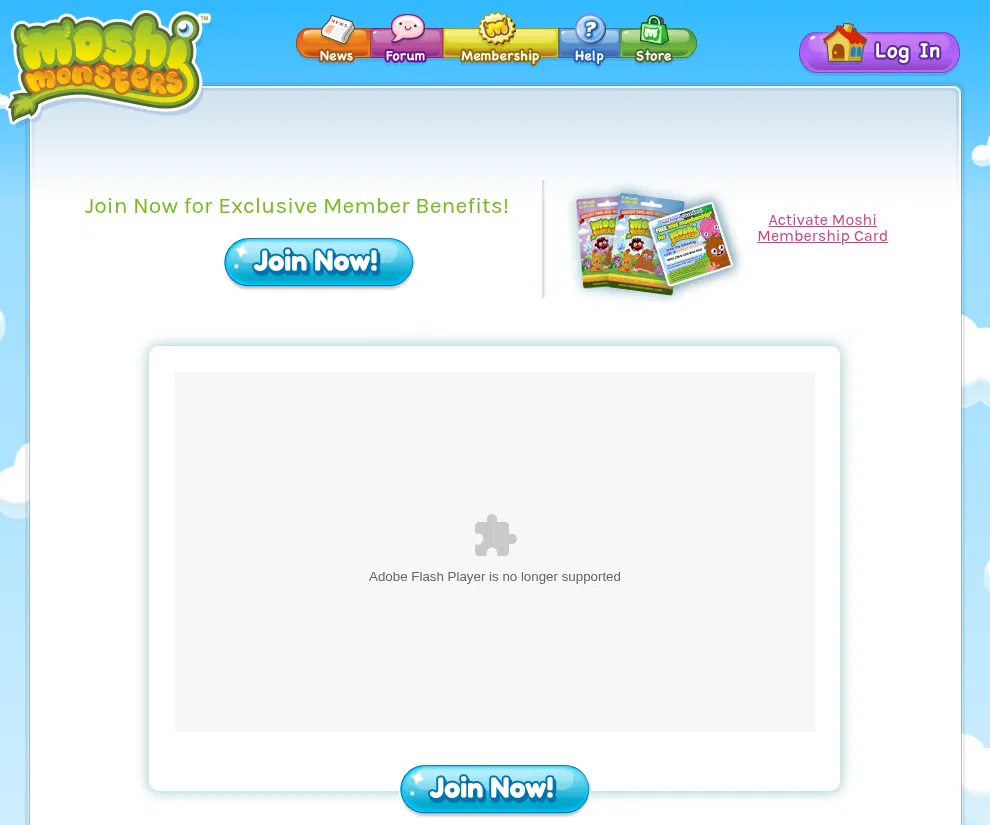
Moshi Monsters was a free browser game where you adopted a pet monster and looked after it. You picked one of six: Katsuma, Poppet, Furi, Diavlo, Luvli or Zommer. Then you named it, chose its colours and moved it into a room of its own in Monstro City.
From the museum

Keeping a monster happy took Rox, the game’s money, and you earned Rox by solving the daily puzzles. They tested spelling, sums and logic, and they quietly got harder if you were doing well. The monsters were educational in sneakier ways too. Mind Candy told parents that your monster’s mood was written in its room, so a child might learn that their monster felt “jubilant” one day and “melancholy” the next.
You spent your Rox on food, furniture and very silly hats. You collected Moshlings, tiny pets you attracted by planting the right seeds, and by 2010 there were more than 40 of them to find. You made friends, left messages on their pinboards and visited their rooms.
As with most games of the era, the best bits cost money. A Moshi membership got you a passport to the Port and Gift Island, a bigger house, the Moshling Zoo, the Underground Disco and the power to change your monster’s colours whenever you liked. You could pay online or buy a membership card in the shops.
Who made Moshi Monsters?
Moshi Monsters was made by Mind Candy, a London company founded in 2004 by Michael Acton Smith, who had co-founded the gadget shop Firebox.com. Mind Candy’s first big idea was Perplex City, a puzzle game that played out across websites, text messages, live events, skywriting and even helicopters. It ate the company’s money, and in 2008 Mind Candy came close to bankruptcy.
The rescue was a monster. TechCrunch later told the story of Acton Smith sitting in a café in Battersea, sketching the first Moshi Monster on the back of a napkin. The game launched in April 2008 for children aged 6 to 12, and it grew slowly at first, creeping up to a million users. Then, in the summer of 2009, it took off, and at one point a new player was signing up every second.
How big did Moshi Monsters get?
Very big, and nowhere more than in Britain. In June 2011 Mind Candy announced 50 million registered users in more than 150 countries, three years after launch, and claimed that more than half of all UK children aged 6 to 12 owned a monster. By 2013 the count was 80 million. Those are registered accounts, not people playing every day, and Mind Candy wouldn’t say how many were still active. But anyone who was at primary school in 2011 will tell you the half-of-Britain claim felt about right.
The monsters didn’t stay on screen for long. There were toys, trading cards, Top Trumps, books and video games. Moshi Monsters Magazine launched in February 2011 at £2.99, and within six months it was the best-selling children’s magazine in the UK, at 113,748 copies an issue. The debut album, Moshi Monsters Music Rox!, went on sale on 2 April 2012 at £8.99, with songs by characters such as Zommer, Poppet and the villain Dr Strangeglove. It reached number four in the album chart, with no help from radio. A feature film followed in December 2013.
Not every plan worked out. In 2011 Mind Candy wanted to release The Moshi Dance, a song by a Moshling pop star called Lady Goo Goo, which was getting about a million views a month on YouTube. Lady Gaga went to the High Court, and in October 2011 she won an injunction that stopped any music by Lady Goo Goo from being released. The recording career was over before the first single. Acton Smith called the ruling “a huge disappointment” and said it was “pretty obvious that kids will be able to tell the difference”.
The money was real. Mind Candy’s turnover rose from £28.9 million in 2011 to £46.9 million in 2012, and licensed goods made up 41% of it. The company had about 200 staff. That year was the peak.
Why did Moshi Monsters shut down?
There are two answers: the children moved to tablets, and the game was built on Flash.
Moshi Monsters was a website at heart, and from about 2011 its young players moved, almost overnight, to tablets and phones. The full game never followed them there. In May 2013 Acton Smith admitted to TechCrunch that web traffic had slowed as tablets took off, and that it was “vital that we crack this”. By 2014 there were seven Moshi apps, but he said none came close to “generating the commercial returns we need for the investments we have made”.
The decline was steep. TechCrunch reported that American visitors to moshimonsters.com fell from 796,000 in August 2013 to 366,000 a year later. Revenue fell in 2013 for the first time. In July 2014 Acton Smith stepped aside as chief executive to concentrate on the creative side, and in September 2014 about 30 people were made redundant, leaving just over 100 staff. “Kids products go through life cycles,” he said. Moshi Monsters was kept running as an “evergreen” brand while the company put its hopes in new games.
Then came the end of Flash. Adobe announced in 2017 that Flash would be retired, and Mind Candy’s chief executive, Ian Chambers, told Engadget the closure had been on their minds since then. “So we have known this moment was coming,” he said. Rebuilding the old game on something else wasn’t “realistic or a sensible business decision”. Engadget also reported that Mind Candy had been on the verge of administration in December 2018, so there wasn’t much spare money for a rescue either.
When did Moshi Monsters shut down?
On 13 December 2019, at midday GMT. Mind Candy put up an “important notice” on the site about a month earlier, and Engadget reported it on 14 November 2019. The notice thanked players “for joining us on the first part of our monsterific journey”, which was very on brand to the last.
Chambers said the game had been “live for 10 and a bit years” and that 100 million kids had played it in that time. He also said that, even then, he was “still surprised by how many people play the Flash game”. It closed a year before Adobe ended support for Flash at the end of 2020, the switch-off that ended an era of Flash games.
The accounts didn’t survive. Mind Candy’s own FAQ now says that when the game closed, “all account data was lost”. Your monster, your Rox and your Moshling Zoo went with it.
Is Moshi Monsters still a thing?
Yes, though not the website you remember. Mind Candy kept the name alive after 2019 with apps for small children: Moshi Kids, a sleep app, and Moshi Play, an activities app. In other words, the monsters went from keeping children up to helping them nod off.
The site at moshimonsters.com is still up, but it’s there to sell merch and talk about the comeback, not to play. Since 2025 there’s been a Moshi shop selling clothes and accessories, and Mind Candy says it wants collectibles and trading cards back too.
Can you still play Moshi Monsters?
Yes, in a way. The original Flash game and its servers are gone, along with everything saved on them. But since the closure, fans have rebuilt the old game from files saved in public archives, including Flashpoint and the Wayback Machine. One of those projects, Moshi Online, announced in 2025 that it was “no longer a fan project but an official part of the Moshi world and the Mind Candy family”, with Mind Candy supporting its costs. It’s still run by the team that built it, it’s free, and it doesn’t sell anything. Because browsers can’t run Flash any more, you play it through a desktop app for Windows, Mac or Linux.
It isn’t the 2019 game come back to life, though. Your old account, monster and Rox aren’t in it, because Mind Candy says all the original account data was lost. Other fan copies still exist, and those aren’t official, so we don’t link to them.
Is Moshi Monsters coming back?
Yes. On 16 June 2025 Mind Candy launched a Kickstarter to make a new Moshi Monsters game for its 20th anniversary in 2027. Its chief executive, Christianne Amodio, said it would be a sequel, not a remake. The story starts after a “Flash-teroid” has wiped out Monstro City, which is a good joke at the expense of the real reason it closed, and players help rebuild it and round up the scattered Moshlings.
The campaign had a rough start. It asked for £250,000, and it seemed to hit that in a day, until Mind Candy found that someone had made fake pledges worth more than half the target. Those were removed, and the campaign was cancelled on 8 August 2025 with £164,120 from 2,478 backers. A second campaign, with a £50,000 target, reached it six hours after going live that August. It ended with £153,891 from 2,840 backers.
The new game is built in Unity, for PC and phones. There’s no membership planned, at least for now: Mind Candy means to make it free to play, with Rox for sale. It starts small: the first ten Moshlings come back first, and the rest may follow. Mind Candy’s FAQ, updated in September 2025, promised Early Access for backers from July 2026. In May 2026 the company said Early Access would start that summer, with a global launch in the third quarter of 2027, and it announced an animated series too, an action-comedy aimed at a late 2028 launch.
None of it is out for everyone yet. When it is, it’ll be the first proper sequel to the game you remember.
Is Moshi Monsters safe?
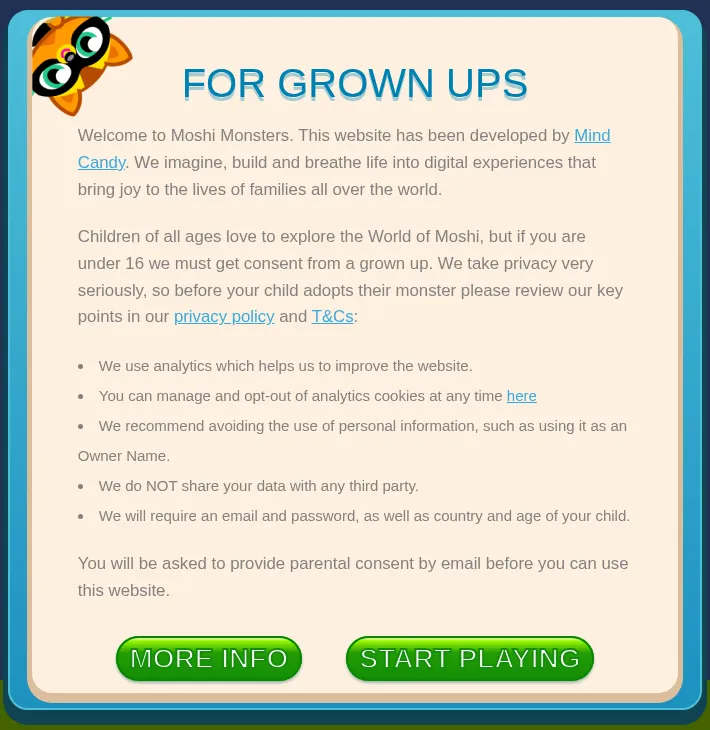
The original was built to be. Mind Candy told parents that fun, education and safety were at its heart, and its parents’ page in 2012 explained how. When a child signed up, Mind Candy emailed a parent for consent, and until a parent agreed, the child couldn’t make friends or post messages. Pinboard messages went through a filter, and each one had a red “M” button to report it to the moderators. Forum posts and blogs were moderated before and after they appeared. To add a friend you needed their monster owner name, and Mind Candy promised it didn’t show or share anything that could identify a child.
By 2019 the game had a page just for grown-ups, saying it needed consent for anyone under 16, advising against putting personal information in an owner name, and promising not to share data with third parties.
Moshi Online says it has trained moderators and tools to report and block other players, and it has messaging between players. Unofficial fan copies answer to nobody but whoever runs them. The new game is too new to judge. As with any game, it’s worth a parent looking first.
Moshi Monsters: a timeline
- 2004: Michael Acton Smith founds Mind Candy in London.
- April 2008: Moshi Monsters launches for children aged 6 to 12, while Mind Candy is close to running out of money.
- Summer 2009: The game takes off, with a new player every second.
- February 2011: Moshi Monsters Magazine launches at £2.99.
- June 2011: Mind Candy announces 50 million registered users.
- October 2011: Lady Gaga’s company wins an injunction against Lady Goo Goo’s music.
- 2 April 2012: Moshi Monsters Music Rox! goes on sale, and soon reaches number four.
- 2012: Mind Candy’s turnover peaks at £46.9 million.
- May 2013: Registered users pass 80 million.
- December 2013: The film comes out.
- July 2014: Acton Smith steps aside as chief executive.
- September 2014: About 30 jobs go at Mind Candy.
- 14 November 2019: Engadget reports the closure notice.
- 13 December 2019: The original game closes at midday.
- 16 June 2025: The first comeback Kickstarter launches.
- August 2025: It’s cancelled, and a second campaign hits its £50,000 goal in six hours.
- By August 2025: Moshi Online announces it’s now an official part of Mind Candy.
- May 2026: Mind Candy announces an animated series for late 2028.
- 2027: The new game’s planned global launch.
There’s a shorter memory of the game on the Moshi Monsters card, and its old rival in the snow is in What happened to Club Penguin? More from the same era waits in The Playground Years.
Opens in a new tab
Sources
Each link opens a saved copy in the Internet Archive’s Wayback Machine, in a new tab, as the page was when we read it.
- 'Moshi Monsters' is shutting down because it runs on Flash (Engadget, 14 November 2019)
- As Moshi Monsters hits 5 years, can it pull off three new games? (TechCrunch, 2 May 2013)
- Mind Candy slims down ahead of major new mobile push (TechCrunch, 18 September 2014)
- A Monster British Success: Moshi Monsters hits 50 million registered users worldwide (Mind Candy press release, June 2011)
- ABC figures reveal Moshi Monsters Magazine is the best selling children's magazine in the UK (Mind Candy press release, 2011)
- Moshi debut album a monster hit (Mind Candy press release, April 2012)
- Launchpad: Moshi Monsters' revenues roar to life with monster rise (Management Today, 2013)
- Gaga gags Mind Candy's Goo Goo (MCV, October 2011)
- Why become a Moshi Member? (moshimonsters.com, July 2010)
- Parents (moshimonsters.com, June 2012)
- About Us (moshimonsters.com, December 2019)
- Mind Candy CEO talks Moshi Monsters comeback (PocketGamer.biz, June 2025)
- Mind Candy cancels Moshi Monsters Kickstarter as it targets campaign relaunch (PocketGamer.biz, August 2025)
- Moshi Monsters' second comeback Kickstarter hits £50,000 goal in six hours (PocketGamer.biz, August 2025)
- Moshi Monsters: Online Virtual Pet Role-Playing Game (Mind Candy on Kickstarter)
- Moshi Online is now part of the Mind Candy family! (The Daily Growl, Moshi Online, August 2025)
- Legal disclaimer (Moshi Online)
- Parents (Moshi Online)
- FAQ (moshimonsters.com, updated 24 September 2025)
- Moshi Monsters returns with new animated TV series amid multi-platform revival (PocketGamer.biz, May 2026)
Do you remember?

From the museum
