

Badger Badger Badger and the Flash cartoon sites
 By Obscure Internet

 11 min read
Badger Badger Badger is a Flash cartoon by the British animator Jonti Picking, known online as Weebl, which first appeared on 2 September 2003: a loop of dancing badgers, a mushroom and, eventually, a snake. Before YouTube, cartoons like it lived on small sites such as Weebl’s Stuff, Albino Blacksheep, Stick Page and eBaum’s World, and all four are still online in 2026, although only eBaum’s World was ever sold for millions.
If you were at a school or office computer in the mid-2000s, you didn’t find these cartoons through a search engine. Someone emailed you a link, or shouted it across the room, and then the whole room had the song stuck in its head until Friday.
What was Badger Badger Badger?
It’s a short Flash loop, officially just called Badgers. Twelve cartoon badgers bob up and down to a chant of “badger, badger, badger”, a mushroom pops up (“mush-mushroom”), and every so often a snake turns up instead (“a snake, a snake snake, a snake, oh, it’s a snake”). Then it starts again. And again. There’s no ending, which was the whole point.
From the museum

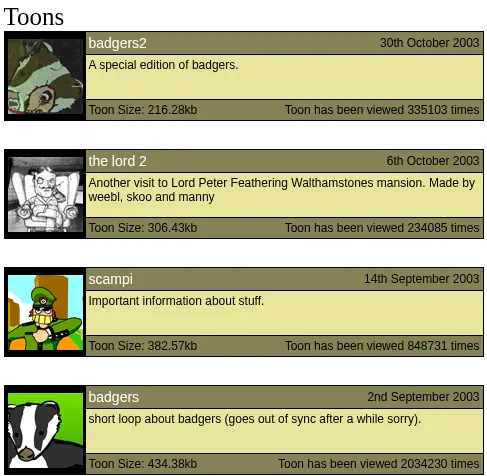
The BFI says it was first shared on the community site B3ta.com and travelled from there through email chains, forums and personal websites. Picking’s own site, Weebl’s Stuff, listed it on 2 September 2003 with the description “short loop about badgers (goes out of sync after a while sorry)”. It weighed 434.38kb, which was still a bit of a wait on a dial-up modem. By the middle of November it had been viewed 2,034,230 times on his site alone, and a “special edition”, badgers2, had joined it.
Fame wasn’t free. On 12 September 2003 Picking wrote that, to make the cartoon “pay for itself (it’s cost a lot in bandwidth bills)”, he was selling the music on CD. Ten days later the site started selling banner adverts at £15 a month. That was the economics of a hit cartoon in 2003: every viewer cost the creator a little bit of money, so a big hit could cost a lot.
Who made Badger Badger Badger?
Jonti Picking, who signs his work Weebl. Before the badgers, he was best known for Weebl and Bob, a Flash series that started in 2002 about two egg-shaped characters who spent most of their time looking for pie and the rest of it bickering.
Picking explained the look of his early work to the Daily Dot in 2012. It was built so that “download times would be minimal even on 56K modems”, and Weebl and Bob were drawn so simply “purely because I wanted them to move smoothly even though Flash was a total hog”. The plain shapes weren’t a lack of ambition. They were engineering.
Badgers has outlived the plug-in it was made in. A copy Picking posted to YouTube has more than 35 million views, the Doncaster Free Press reported in June 2026, and in 2013 he made a single, Save the Badger Badger Badger, with Brian May and Brian Blessed. In 2026 the British Film Institute added Badgers to the BFI National Archive’s new online video collection, which means a cartoon about badgers and a mushroom is now kept on two robot-operated tape libraries, with a backup 50 miles away. You can watch it legitimately on BFI Replay, where the BFI calls it “one of the defining viral hits of the Flash-animation era”.
Where did people watch Flash cartoons before YouTube?
On dozens of small sites, each with its own taste and its own crowd. The biggest open portal was Newgrounds, where anyone could upload and the audience voted. Around it grew a ring of smaller places: an artist’s own site like Weebl’s Stuff, collections like Albino Blacksheep, specialists like Stick Page, and aggregators like eBaum’s World, which gathered funny things from everywhere into one place.
A Flash cartoon was a single small file, so it travelled easily. The same animation could turn up on four or five sites in a week, sometimes with credit and sometimes without. You’d watch it in a browser window with a plug-in that was on almost every computer, and if it was any good, you’d send the link to everyone you knew.
Homestar Runner, made and shown on its own site, has an exhibit of its own.
What is Albino Blacksheep?
Albino Blacksheep is a Canadian site for animation, music, games and oddities, run by Steven Lerner, and it’s one of the oldest of the bunch: its own footer dates it from 1996. In the 2000s it was where a lot of people saw Flash cartoons for the first time, because it collected the good ones, credited the people who made them and kept them online.
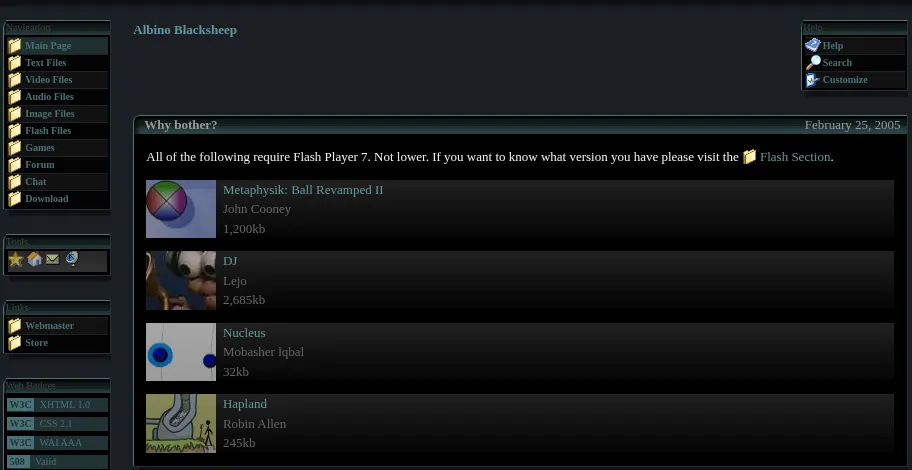
Its home page in 2005 reads like a record shop’s new arrivals. Each post listed a handful of new Flash files with the maker’s name and the file size in kilobytes, so you could judge whether your connection was up to it, under a warning that you’d need Flash Player 7, “Not lower.”
Plenty of 2000s classics had a home there. The Llama Song, Burton Earny’s cheerfully nonsensical song about llamas, was on the site by February 2005. Alan Becker’s Animator vs. Animation, in which a stick figure fights back against the person drawing it, was up by June 2006. Albino Blacksheep’s own “Playlist of Historical Significance” today includes both, alongside Badgers and The Ultimate Showdown of Ultimate Destiny.
Is Albino Blacksheep still around?
Yes. Its About page in October 2026 says it still publishes new and original work, and that it’s still free to browse. It also calls itself, with some justification, “an official home to numerous Internet classics”, and it puts it nicely: “Depending on your age, Albino Blacksheep could mean different things to you.”
What was Stick Page?
Stick Page was the home of the stick-figure fight. It began as Jason Whitham’s own site: in November 2002 its title was “Home of Crazy Jay the Ninja and the Operation stick movies”, with mirrors on Newgrounds for anyone whose download kept failing, and a link to contact Jason Whitham at the bottom.
Stick fights were already a craze by then, and the man most responsible was Zhu Zhiqiang, a self-taught animator in Beijing. His Xiao Xiao series made a lone stick figure take on a whole army in kung fu brawls with moves borrowed from Jackie Chan films and The Matrix. Xiao Xiao No. 3, which took him seven months of spare time, came out in April 2001, and Animation Obsessive reports that he got 1,200 emails in a single day afterwards, 80% of them from outside China. By late 2001 it had more than half a million views on Newgrounds, before you count the many other sites that hosted it.
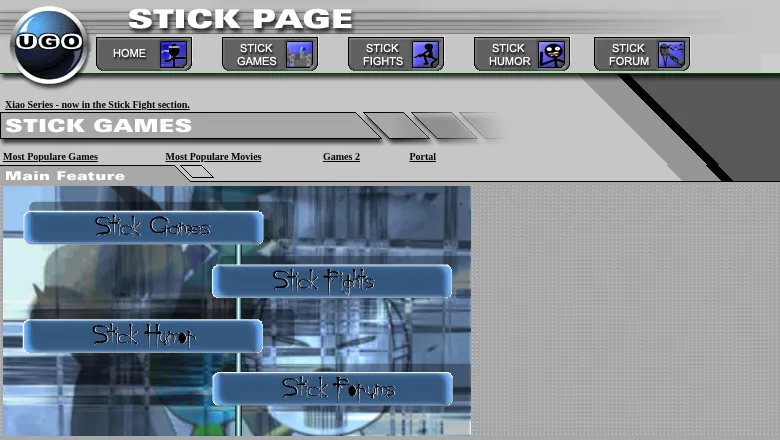
By 2005 Stick Page described itself as the place for stick figure movies and stick games, “Xiao Xiao style”, split into Stick Games, Stick Fights, Stick Humor and a forum, with the Xiao Xiao series filed under Stick Fights.
Is Stick Page still around?
The site is still online, but it’s very quiet. In October 2026 the front page still carried a 2013 copyright line, links to the games Stick Empires and Stick War: Legacy, and a news post announcing the alpha test of Stick War: Legacy on Android, “Our ultimate goal is to have the final launched to Google Play in the next month”. That’s Stick Page announcing a game of its own: Stick War: Legacy is a phone version of Stick War, a Flash strategy game that was on the site by 2009. If you’re after Stick War today, the app stores are where the official version lives. The old Flash stick fights were made for a plug-in that browsers no longer run.
What is eBaum’s World?
eBaum’s World is a humour website, started by Eric Bauman in Rochester, New York. In the 2000s it was one of the biggest places online for funny videos, Flash cartoons, games and prank calls, and today it’s a site of picture galleries, videos and memes.
Unlike the others, it didn’t make much of its own material. It collected things. Wired’s 2006 profile describes Bauman’s content manager sifting through thousands of videos, animations, jokes, photos and games, with Bauman picking eight new links a week to add to the site.
When was eBaum’s World created?
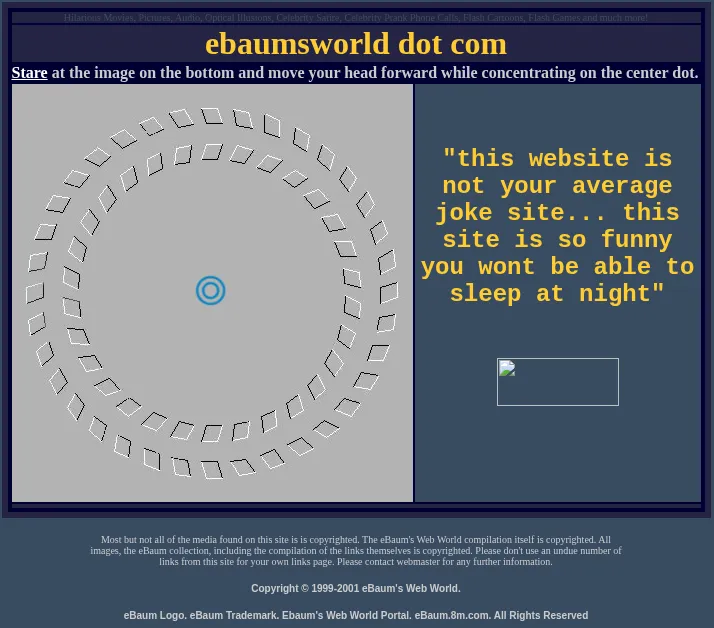
In 1998. According to Wired, Bauman launched it as his homepage that year, while he was a senior at high school, and when HandHeld Entertainment bought the company in 2007 it too gave 1998 as the founding year. The oldest copy in the Wayback Machine, from December 2001, still calls it eBaum’s Web World in the small print, and welcomes you to “my personal collection of hilarious media!”
By 2006 it was a real business, run from a 19th-century farmhouse in Rochester with 30 employees, according to Wired, and it had signed a deal with Fox TV Studios in June 2005.
It also had a reputation. Wired reported that detractors said Bauman built the site on other people’s work, taking media from around the web, removing or ignoring credits and adding the eBaum’s World watermark, and that creators on sites including Something Awful, Newgrounds and You’re the Man Now Dog had complained about it for years. Bauman disputed some of it, and by 2006 the site required uploads to come through a form with a consent-and-release agreement and had started paying for content, usually less than $250. “I may have made mistakes early on,” he told Wired. “Maybe I could have done a better job of tracking down authors.”
What happened to eBaum’s World?
It was sold, and then sold again. In August 2007 HandHeld Entertainment agreed to buy eBaum’s World for $17.5 million at closing, with up to $32.5 million more depending on how the site performed over three years. The company said it had made about $5.2 million in revenue in 2006. In February 2009, Waxy.org reported that Bauman had been fired from the site that carried his name, along with the rest of the staff.
In April 2016, GeekWire reported that Literally Media, a new company owned by the Israeli advertising technology veteran Jacob Nizri, had taken a controlling stake in eBaum’s World, alongside Cheezburger, the company behind I Can Has Cheezburger and Know Your Meme. Literally Media still owns it: the footer in October 2026 reads “Copyright © 1998-2026 Literally Media”. The site is still busy, with picture galleries, videos, games and a section called Internet Classics, though it’s now much more a list-and-meme site than the Flash cartoon cupboard it used to be.
How did YouTube end the Flash cartoon sites?
Slowly, then all at once. YouTube’s first video went up in April 2005, and the site made sharing a video as easy as sharing a link, with someone else paying the bandwidth bill. For an animator who’d once sold CDs to cover the cost of a hit, that was a hard offer to refuse.
Picking described the trade-off to the Daily Dot in 2012: “I’m not even sure weebls-stuff.com is a destination site any more as the Internet has probably become a lot more centralised around the big sites like YouTube.” He wasn’t bitter about it. “YouTube has allowed a lot of people with good ideas make a living doing something entertaining,” he said, but “you give up a lot of control by moving to where people can best see your work.”
Then Flash itself went. The plug-in that ran every one of these cartoons was switched off by its makers, and the long story of that is in What happened to Flash games? Sites that wanted to keep their old work had to turn it into video or find another way to play it. If you’ve ever seen the grey jigsaw piece where a cartoon used to be, there’s a card for that: Adobe Flash Player is blocked.
Are the Flash cartoon sites still around?
Surprisingly, all four of these are.
- Weebl’s Stuff is still Jonti Picking’s site, with his toons, Weebl and Bob, a shop and links to his YouTube channel.
- Albino Blacksheep is still free to browse, and says it still publishes new work.
- Stick Page is online, but its front page hasn’t moved on from the 2010s. Its game Stick War lives on in the app stores as Stick War: Legacy.
- eBaum’s World is a busy humour site owned by Literally Media, with galleries, videos and memes.
None of them is where you’d go first any more. That’s YouTube now, and has been for a long time. But each of them was, briefly, the most important website in a classroom somewhere.
The Flash cartoon sites: a timeline
- 1996: The earliest year in Albino Blacksheep’s footer.
- 1998: Eric Bauman launches eBaum’s World as his homepage in Rochester, New York.
- April 2001: Zhu Zhiqiang’s Xiao Xiao No. 3 makes stick-figure fights a worldwide craze.
- 2002: Weebl and Bob begins, and Stick Page is the home of Crazy Jay the Ninja.
- 2 September 2003: Badgers appears, and passes two million views on Weebl’s Stuff by mid-November.
- 12 September 2003: Weebl starts selling the Badgers music to pay the bandwidth bills.
- April 2005: The first video goes up on YouTube.
- June 2005: eBaum’s World signs a deal with Fox TV Studios.
- October 2006: Wired profiles eBaum’s World and the row over credit for other people’s work.
- August 2007: HandHeld Entertainment agrees to buy eBaum’s World.
- Early 2009: Eric Bauman and the rest of the eBaum’s World staff are fired.
- 2013: Picking releases Save the Badger Badger Badger with Brian May and Brian Blessed.
- April 2016: Literally Media takes a controlling stake in eBaum’s World.
- 2026: The BFI preserves Badgers in its online video collection.
There’s more from the same years in the Messenger Years.
Opens in a new tab
Sources
Each link opens a saved copy in the Internet Archive’s Wayback Machine, in a new tab, as the page was when we read it.
- Toons (Weebl's Stuff, November 2003)
- News (Weebl's Stuff, September 2003)
- Badgers (BFI Replay, BFI National Archive)
- Doncaster animator's viral badgers video added to British film archives (Doncaster Free Press, 2 June 2026)
- Weebl on Weebl: Web star Jonti Picking reflects on his Internet empire (The Daily Dot, 2 May 2012)
- Albino Blacksheep (home page, March 2005)
- The Llama Song (Albino Blacksheep, February 2005)
- Animator vs. Animation, by Alan Becker (Albino Blacksheep, June 2006)
- About (Albino Blacksheep, October 2026)
- Stick Page: Home of Crazy Jay the Ninja and the Operation stick movies (Stick Page, November 2002)
- Stick Page (home page, June 2005)
- Stick Page (home page, October 2026)
- When Stick Figures Fought (Animation Obsessive)
- eBaum's Web World (home page, December 2001)
- Dude, That Is So Not Funny, by David Kushner (Wired 14.10, October 2006)
- Handheld buys entertainment site eBaum for up to $32.5M (VentureBeat, 3 August 2007)
- Eric Bauman fired from Ebaumsworld, along with rest of staff (Waxy.org, 2 February 2009)
- Cheezburger joins forces with online comedy rival eBaum's World in acquisition by Israeli media firm (GeekWire, 21 April 2016)
- Weebl's Stuff (home page, October 2026)
- Stick Page (home page, December 2009)
- eBaum's World (home page, October 2026)
From the museum
